How All me differs from traditional social networks is fundamental to the reasons why its being developed.
The All me app is a new kind of social platform designed around the principle of “Privacy by Default.” Unlike mainstream social networks, its goal is to give people back their digital freedoms allowing them to connect, share, and interact without constant surveillance, profiling or judgment.
Structural Differences (Ownership, Control, Incentives)
Traditional Social Networks
- Owned by for-profit corporations
- Shareholders and investors ultimately drive decisions
- Platforms are assets that can be sold, merged, or monetised
- Users are participants, but not stakeholders
Result:
Business incentives favour growth, engagement, and data extraction.
All me
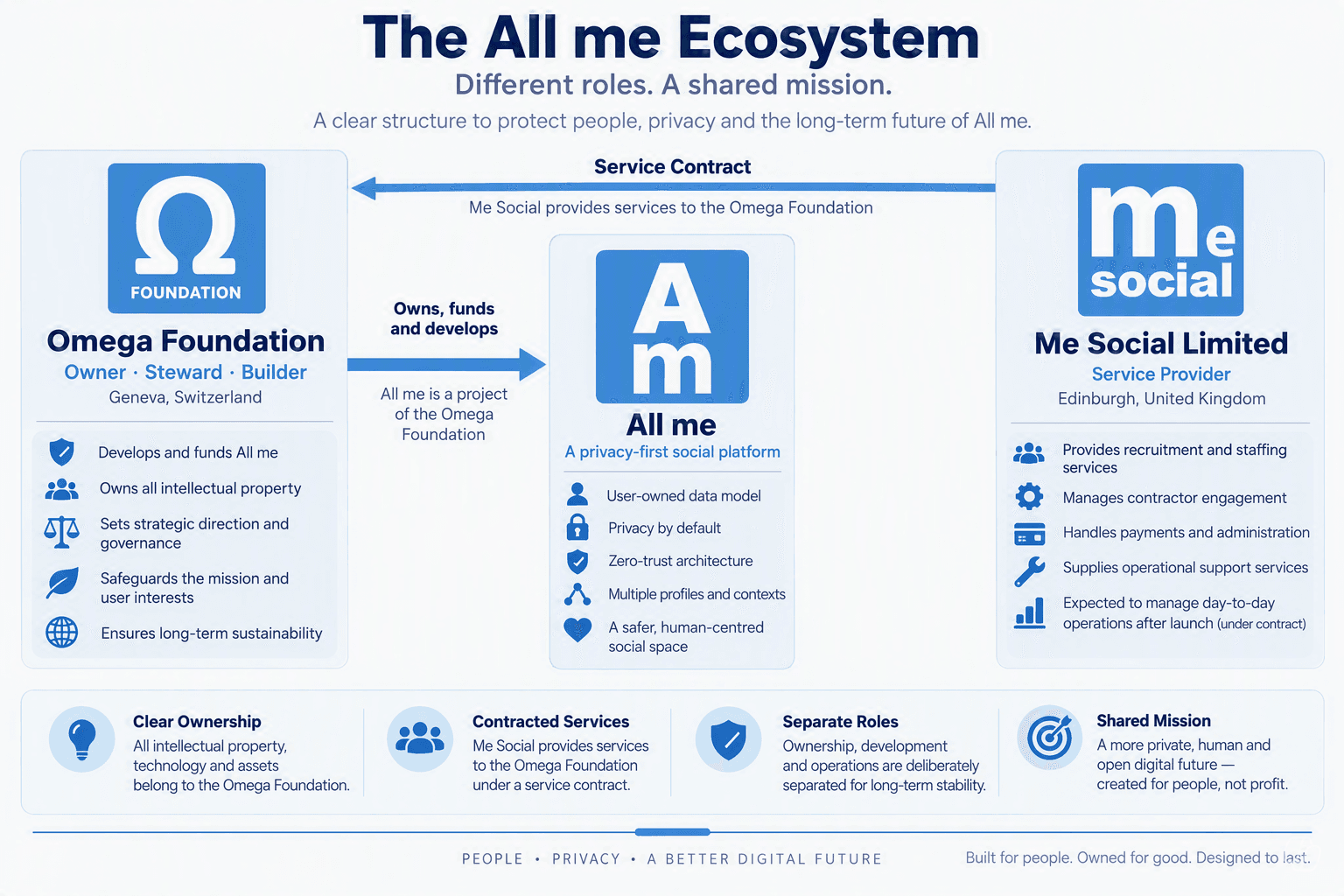
- Owned by a Swiss foundation (nonprofit, asset-locked)
- Core platform cannot be sold or equity-financed
- Operating work is done by service companies under contract
- Governance is designed to prioritise purpose over profit
Result:
The platform is structurally protected from investor pressure and hostile monetisation.
Technical & Architectural Differences (Data, Identity, Control)
Traditional Social Networks
- Centralised identity
- One “real” account per person (even if unofficial alts exist)
- Persistent profiling
- Activity across the platform is linked and analysed
- Data maximisation
- Collect as much behavioural data as legally possible
- Algorithms optimise for:
- Engagement
- Time-on-platform
- Emotional amplification
Result:
Users are legible, predictable, and monetisable.
All me
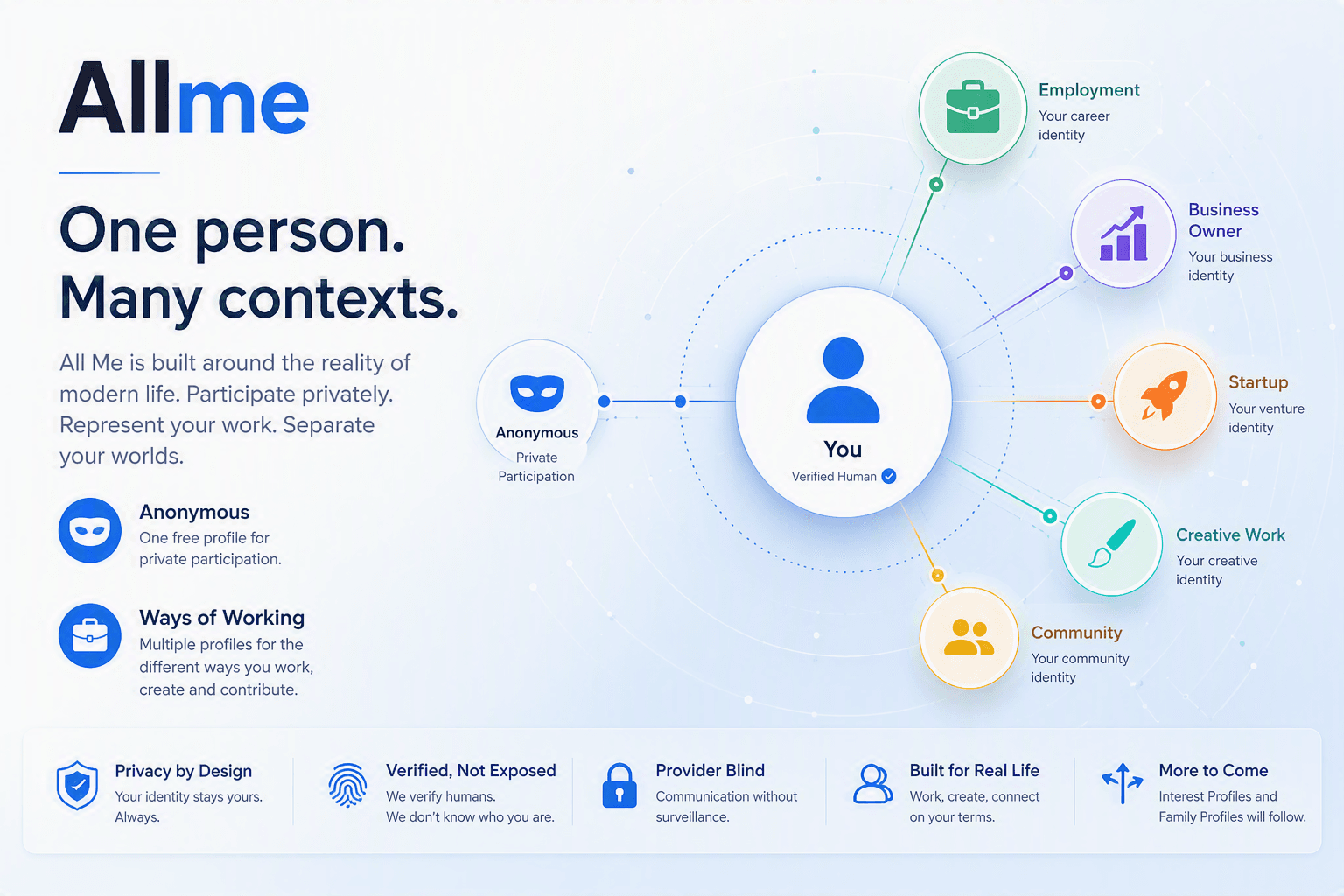
- Identity separation by design
- Multiple independent personas (personal, anonymous, professional)
- No enforced linkage between identities
- Data minimisation
- Collect only what is functionally required
- Privacy by default
- No behavioural profiling for ads
- No cross-persona tracking
- Architecture designed to reduce:
- Correlation
- Surveillance
- Algorithmic manipulation
Result:
Users retain contextual control over who they are and how they appear.
Monetisation Model (Where the Money Comes From)
Traditional Social Networks
- Advertising-driven
- Revenue depends on:
- User attention
- Data quality
- Predictive accuracy
- Users are the product, advertisers are the customers
Incentive loop:
More tracking > better ads > higher revenue
All me
- No advertising
- No sale of personal data
- Revenue intended to come from:
- Subscriptions
- Micropayments
- Ecosystem services
- Explicit rejection of:
- VC funding
- Private equity
Incentive loop:
Better user experience > willingness to pay > sustainability
Governance & Power Dynamics
Traditional Social Networks
- Governance is:
- Internal
- Opaque
- Shareholder-aligned
- Users have little recourse beyond leaving
- Policy changes are unilateral
All me
- Governance anchored in:
- Foundation statutes
- Board oversight
- Contractual limits on operators
- Design intent:
- Replace “trust us” with structural constraints
- Operators can be replaced without selling the platform
Growth Philosophy
Traditional Social Networks
- Growth-first
- Network effects above all else
- Scale often precedes safety, governance, or ethics
All me
- Sustainability-first
- Accepts slower growth in exchange for:
- Trust
- Privacy
- Long-term legitimacy
- Designed for durability, not blitz-scaling
Summary Table

Bottom Line
All me is not trying to be a “better Facebook.”
It is trying to be a different class of social infrastructure:
- Less extractive
- Less scalable in the short term
- More aligned with user autonomy and privacy