
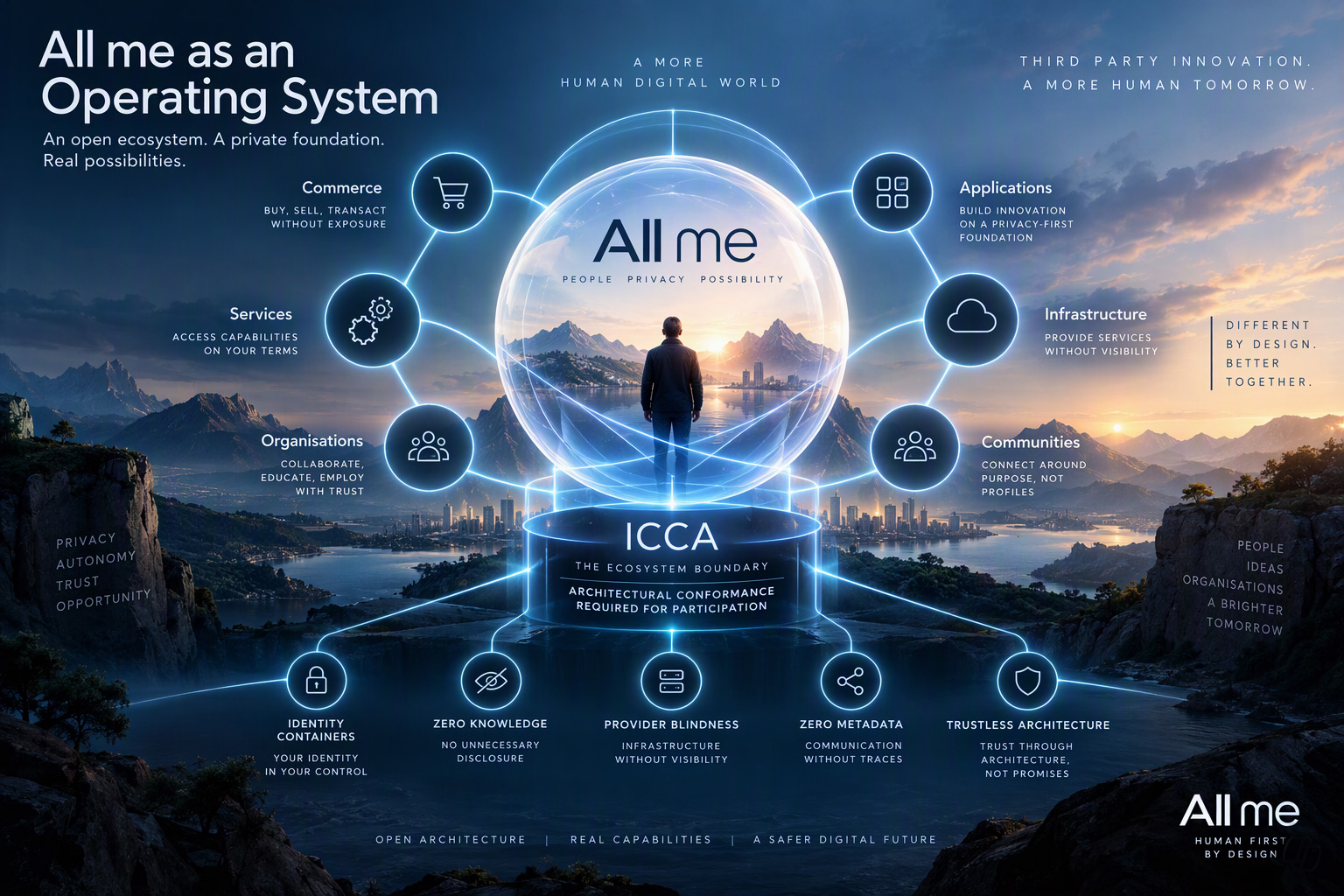
Most digital platforms think about ecosystems in terms of access.
They provide APIs, developer accounts, application marketplaces and integration frameworks. Third parties are invited inside the platform and are progressively granted access to users, identities, data and behavioural information.
All me takes a fundamentally different position.
If All me is considered not simply as an application, but as an operating system for private digital interaction, then the important architectural question becomes:
Where can another system interact with All me without destroying the properties that make All me trustworthy?
That question leads directly to ICCA, the Identity Constructed Communication Architecture.
ICCA emerged from the engineering of All me and formalises an architecture in which identity constructs communication rather than being transported through provider-visible channels. Its architectural core describes sealed identity containers, momentary trust tokens, zero-metadata transport and blind-provider operation.
Those properties have an important consequence for the future All me ecosystem:
Third parties can participate in All me, but they cannot redefine the architectural conditions under which participation occurs.
This changes what a digital ecosystem means.
From Platform to Operating System
A conventional social platform owns the environment in which relationships occur.
Applications integrate with the platform. Data moves between systems. Identity becomes an integration object. APIs expose functionality and, frequently, information about the person using it.
Thinking about All me as an operating system creates a different model.
The operating system establishes the fundamental conditions under which interaction occurs. Services then operate above those conditions.
The useful analogy is therefore not:
All me → API → third-party application
but:
All me → ICCA boundary → compliant capability → third-party service
The distinction matters.
An API tells a developer how to communicate with a system.
ICCA determines what forms of communication the system is architecturally permitted to support.
The public description of All me’s ICCA model explicitly distinguishes this from conventional visibility-based architectures: providers supply infrastructure without visibility and trust is established cryptographically rather than behaviourally.
So ICCA is not another API standard.
It is the architectural constitution of the ecosystem.
The Ecosystem Boundary
All me can therefore support a large third-party ecosystem without becoming a conventional data platform.
The critical separation is between capability and visibility.
A third party may be able to provide a capability without acquiring a persistent observational position over the person exercising that capability.
Conceptually, the architecture becomes:
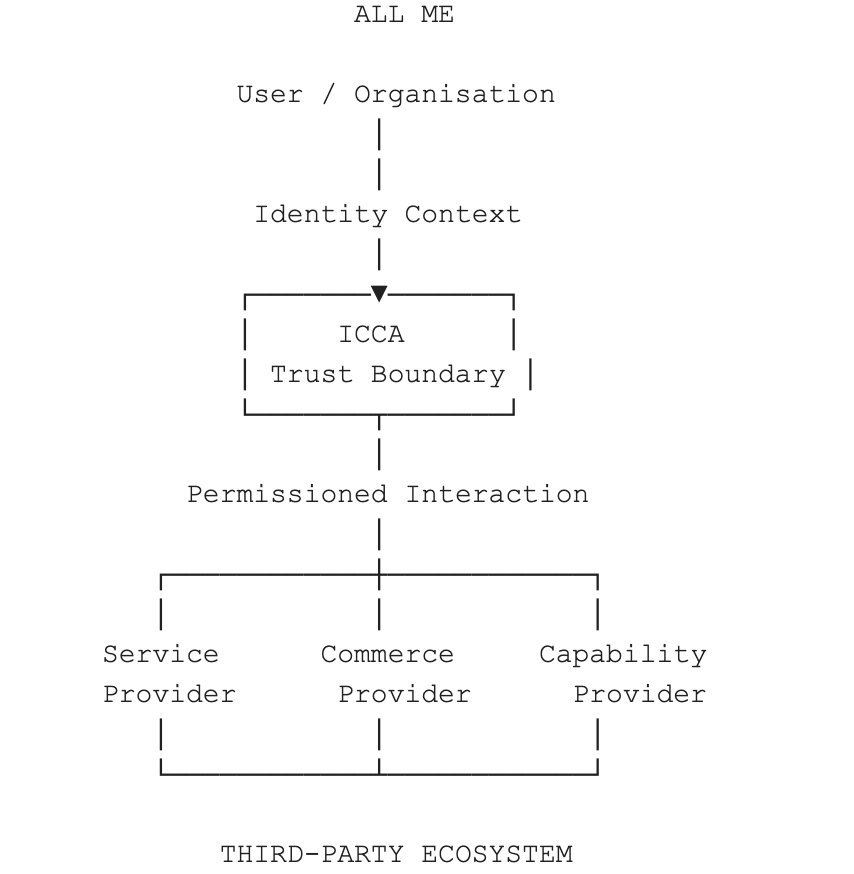
The important element is the line in the middle.
It is not simply an authentication boundary.
It is an architectural boundary.
Anything interacting across it must preserve the relevant ICCA invariants.
Where Third Parties Can Interact
This produces several potential classes of ecosystem participation.
Capability Providers
A third party could provide functionality that All me itself does not need to own.
Instead of absorbing that provider into the All me trust domain, All me can potentially expose the required capability through an ICCA-compliant interaction boundary.
The distinction is significant.
All me does not necessarily need to become the provider of everything.
It needs to preserve the architecture through which everything is accessed.
Commercial Services
Commerce represents another natural ecosystem boundary.
The ICCA framework already extends beyond communication into commerce, and the published ICCA description explicitly identifies communication, commerce and social interaction as domains to which the architecture can be applied.
This allows the commercial ecosystem to be considered separately from the identity infrastructure.
A merchant needs sufficient information to execute an authorised transaction.
That does not automatically mean the merchant should obtain a permanent observational relationship with the individual.
That distinction could become one of the most important characteristics of an All me marketplace.
Organisational Services
All me is also relevant to organisations, not merely individuals.
Your ICCA paper explicitly includes an organisational identity fabric within the All me architecture.
That creates the possibility of organisations participating as service providers, employers, institutions or other recognised entities while still operating within ICCA’s architectural trust boundaries.
The organisation becomes a participant in the environment rather than an observer of the environment.
Infrastructure Providers
Infrastructure itself can potentially be supplied by external organisations.
This is perhaps the most radical implication of provider blindness.
If blindness is structurally enforced rather than contractually promised, infrastructure provision and informational power can begin to separate.
In ICCA’s architectural core, provider blindness is an engineered property alongside zero-metadata transport and identity containment.
Consequently, participation in infrastructure does not have to imply participation in identity.
ICCA Compliance Becomes the Admission Requirement
This is where the ecosystem model differs fundamentally from the familiar app-store approach.
A conventional ecosystem asks:
Does your software work with our platform?
All me can ask a more consequential question:
Does your software preserve the architectural properties of the environment?
Compatibility alone is insufficient.
A third-party component could be technically excellent while creating persistent identifiers, metadata continuity or provider visibility that contradicts ICCA.
Allowing such a component inside the ecosystem would weaken the system precisely at the point where external participation begins.
Therefore, ICCA adoption should not be treated merely as a recommendation for third-party developers.
It becomes the condition of architectural participation.
Not Certification of Intent, but Conformance of Architecture
There is an important distinction here.
Traditional privacy ecosystems often depend upon agreements.
A company promises to handle information responsibly. Policies define acceptable behaviour. Contracts constrain subsequent processing. Regulators provide external enforcement.
ICCA is predicated on a stronger idea: certain undesirable behaviours should be removed through architecture rather than merely prohibited through policy.
The published ICCA Architectural Core describes trustlessness as being achieved through architecture rather than policy.
That gives the All me ecosystem a potentially powerful design principle:
Do not ask third parties to promise not to violate properties that the architecture can prevent them from violating.
The ecosystem therefore becomes less dependent upon trusting every participant.
Instead, participants operate inside a common architectural geometry.
An Ecosystem Without an Identity Marketplace
This may ultimately be one of the most important distinctions between All me and today’s platform ecosystems.
In many contemporary digital ecosystems, identity is economically valuable because access to identity enables profiling, attribution, targeting and continuing relationships.
ICCA proposes something structurally different.
Its published framework describes momentary channels, non-derivable routing and containerised trust boundaries designed to eliminate provider visibility, behavioural inference and metadata continuity.
That suggests a very different basis for ecosystem economics.
The third party competes on the value of the capability it provides rather than on the amount of information it can extract from the relationship.
That is a profound change.
The ecosystem can still contain businesses.
- It can still contain transactions.
- It can still contain organisations.
- It can still contain innovation.
What it does not need is an identity market hidden underneath those activities.
ICCA as the Ecosystem Protocol
This is why the relationship between All me and ICCA becomes strategically important.
All me is the operating environment.
ICCA defines the architectural rules by which trustworthy participation in that environment becomes possible.
And because ICCA has deliberately been published as an open architecture, it need not remain exclusive to All me. The published ICCA material describes the framework as open for adoption and extension, with the intention of supporting wider privacy-centric digital ecosystems.
That creates an interesting possibility.
Third parties may adopt ICCA independently of All me.
If they subsequently interact with All me, they are not merely integrating with another proprietary platform. They are participating through a shared architectural model.
Over time, the distinction becomes important:
All me does not need to own the entire ecosystem.
It needs to protect the integrity of the architecture at its boundary.
The Operating-System Principle
Thinking about All me as an operating system therefore changes the strategic objective.
The ambition is not to put every possible feature inside All me.
Quite the opposite.
A mature operating environment should be able to remain comparatively small at its trusted core while allowing enormous diversity beyond that core.
The architectural objective becomes:
Maximum ecosystem diversity with minimum expansion of the trust boundary.
ICCA provides the mechanism for maintaining that distinction.
Third parties can innovate.
Organisations can participate.
Commercial services can emerge.
Infrastructure can be distributed.
New capabilities can be introduced that were never anticipated when All me itself was designed.
But none of those extensions should require All me to surrender the architectural principles on which the environment is built.
That leads to a simple rule for the ecosystem:
You do not have to be All me to participate in All me.
You do have to speak ICCA.
That may ultimately be the most important characteristic of All me as an operating system.
It transforms ICCA from the architecture inside All me into the architecture of the boundary around which an ecosystem can form.


