
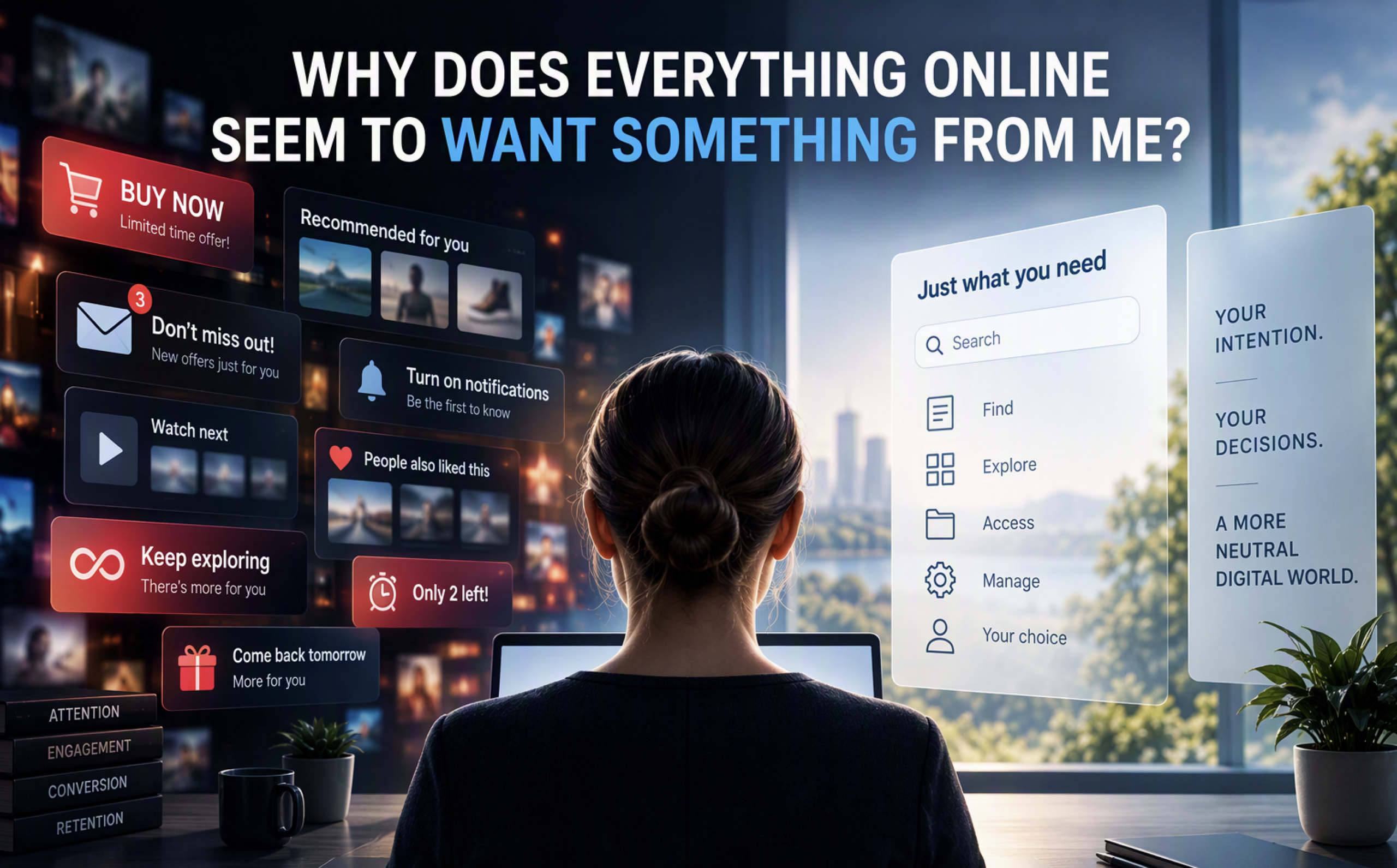
Open almost any digital service and something is competing for your attention.
- Click this.
- Watch this.
- Buy this.
- Read this next.
- Stay a little longer.
- Come back tomorrow.
We have become so familiar with these prompts that they barely register anymore.
But step back for a moment and there is an interesting question:
Why does the technology I use need an outcome from my behaviour?
Why can’t it simply provide the service I asked for?
When the system has an objective for you
Most organisations understandably want their digital services to succeed.
They want customers to engage, purchase, subscribe, return and recommend.
But there is an important distinction between making a service valuable enough that people choose to return and designing a system specifically to produce that behaviour.
- The first creates value.
- The second creates influence.
And once influencing behaviour becomes part of the operating model, the relationship between the organisation and the individual changes.
The system is no longer simply serving the person.
It has an objective for them.
What would a neutral system look like?
Imagine opening a digital service where nothing is trying to influence what you do next.
- There is no feed deciding what deserves your attention.
- No recommendation engine deciding what you should discover.
- No artificial urgency encouraging you to act.
- No optimisation designed to keep you engaged.
Instead, the system provides the tools.
- You provide the intention.
- You search because you want to search.
- You discover because you want to explore.
- You leave when you have finished.
And importantly, the system has no reason to regard your departure as failure.
For a greenfield business
Behavioural neutrality creates a very different starting point for designing a new service.
Instead of asking:
How do we maximise engagement?
the organisation can ask:
How effectively did we enable the person to accomplish what they came here to do?
Those questions can produce fundamentally different products.
One prioritises the objectives of the platform.
The other prioritises the objectives of the person.
For existing organisations
For established businesses, behavioural neutrality presents a more difficult challenge.
Engagement, conversion, retention and attention may already be embedded within performance measures and commercial models.
The question is therefore not whether organisations should stop trying to create successful customer experiences.
It is whether success must depend upon changing customer behaviour.
A customer who visits, accomplishes something quickly and leaves might currently appear less “engaged”.
But perhaps that interaction was exceptionally successful from the customer’s perspective.
That difference matters.
Neutrality does not mean passivity
A behaviourally neutral system can still be useful.
- It can organise information.
- It can enable search.
- It can help people navigate.
- It can provide choices.
- It can respond when asked.
What changes is who determines the objective.
- The system facilitates.
- The person decides.
There is no hidden requirement that the individual’s behaviour must move in a direction that benefits the provider.
The executive question
Look at the digital experiences your organisation provides.
Then ask:
How many features exist because customers genuinely need them, and how many exist because we want customers to behave differently?
That is the adoption question behind ICCA Design Principles: Behavioural Neutrality.
It takes the principle of human autonomy one step further.
Human autonomy says the person must remain free to choose.
Behavioural neutrality asks whether the system should be trying to influence that choice in the first place.
The underlying ICCA work is openly shared under a Creative Commons Attribution-ShareAlike 4.0 licence, encouraging discussion, challenge, adaptation and further development.
The paper describes the architectural principle. This article asks what digital services might become when the technology stops wanting something from us.
#ICCA #BehaviouralNeutrality #HumanAutonomy #DigitalTrust #EthicalTechnology #CustomerExperience #Leadership #DigitalTransformation #HumanCentredDesign #CreativeCommons
