
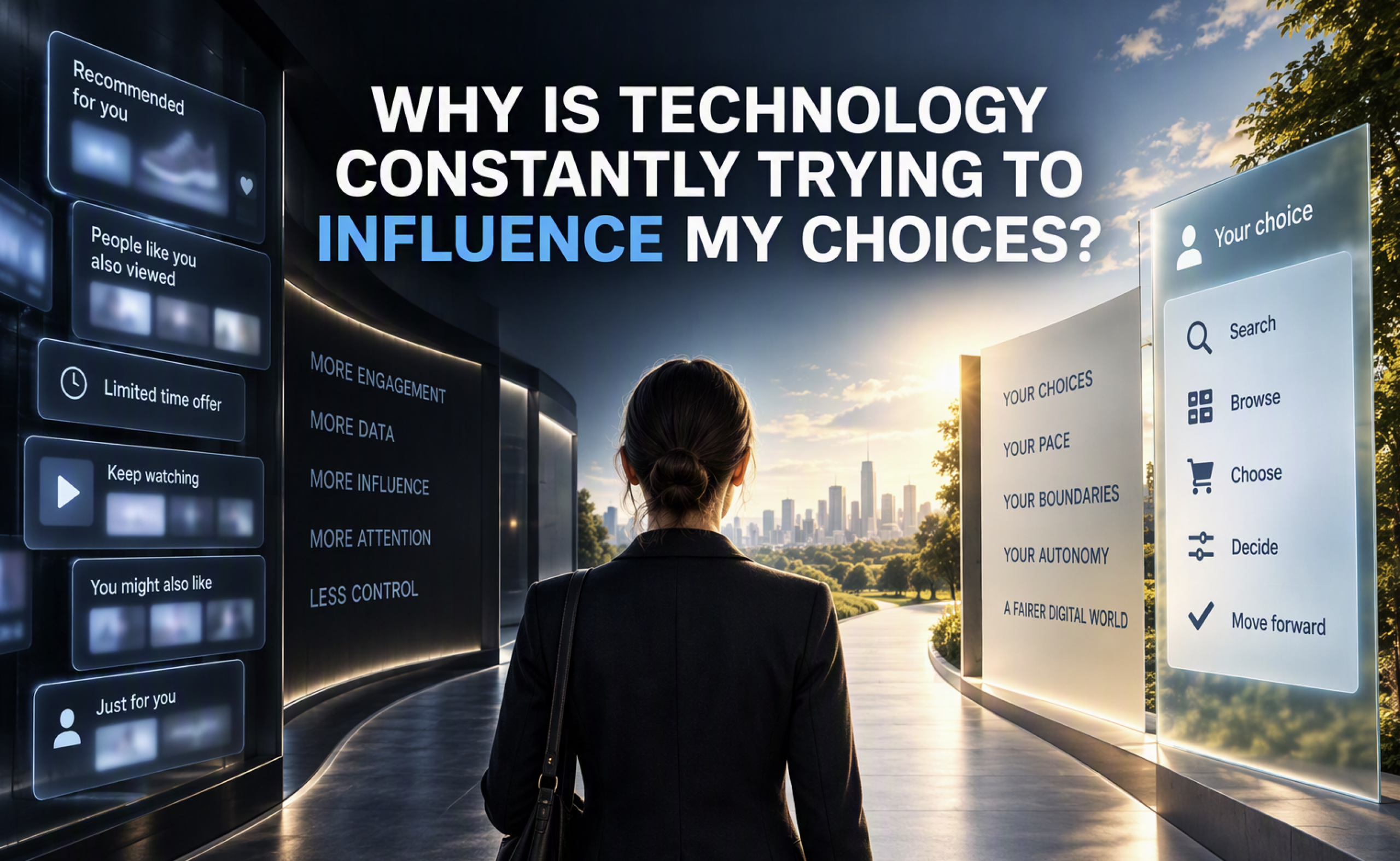
Think about an ordinary day online.
You open an app and something has already been selected for you.
You visit a website and something is recommended.
You read an article and another one is waiting.
You watch something and the next thing starts automatically.
You browse a product and suddenly it seems to follow you everywhere.
Individually, these interactions can appear harmless. Some can even be useful.
Taken together, however, they reveal an assumption that has become deeply embedded in digital design:
The system should try to influence what I do next.
But why?
When did helping become influencing?
There is an important difference between helping someone make a decision and trying to make the decision for them.
A good assistant can present choices.
A navigation system can explain possible routes.
A shop can organise products so they are easier to find.
None of those things inherently requires predicting, steering or optimising the person’s behaviour.
Yet much of the digital economy has moved beyond supporting decisions towards attempting to influence them.
Engagement becomes something to maximise.
Attention becomes something to retain.
Behaviour becomes something to predict.
The person gradually becomes an optimisation problem.
What if autonomy were a design requirement?
We normally think about human autonomy as an ethical principle.
But what happens if it becomes a system constraint?
Instead of asking:
How effectively can we influence this person?
the design question becomes:
How do we ensure the person remains the decision-maker?
That is a fundamentally different starting point.
The system can still provide information.
It can still make services easy to use.
It can still help people discover things.
But it cannot depend upon manipulating behaviour to achieve its objectives.
For a greenfield business
For a new service, this creates an opportunity to make autonomy part of the architecture from the beginning.
Success does not have to mean keeping somebody engaged for as long as possible.
The objective can simply be to help the person accomplish what they came to do.
That can produce a very different customer relationship.
Use the service because it creates value, not because the system has become exceptionally good at keeping you there.
For established organisations
The question may be considerably harder.
Many organisations already use engagement, conversion, retention, recommendation and personalisation as important measures of digital performance.
There is nothing inherently wrong with those objectives.
The challenge is understanding where assistance ends and influence begins.
And that leads to an uncomfortable executive question:
Are we designing better experiences for our customers, or better customer behaviour for ourselves?
The distinction matters.
Autonomy can change the relationship
If people know that a system is not trying to manipulate their behaviour, the relationship between person and provider changes.
The organisation no longer needs to constantly decide what the individual should see next.
Instead, the individual decides.
Technology facilitates.
The person remains in control.
This does not make technology less intelligent.
It places a boundary around what that intelligence is permitted to do.
A Question for Leaders
Look at your own digital services.
- Recommendations.
- Notifications.
- Defaults.
- Personalisation.
- Engagement mechanisms.
Then ask:
Are these helping customers make their own choices, or are they designed to influence those choices?
That is the adoption question behind ICCA Design Principles: Human Autonomy as a System Constraint.
The underlying ICCA work is openly shared under a Creative Commons Attribution-ShareAlike 4.0 licence, encouraging discussion, challenge, adaptation and further development.
The paper describes the architectural principle. This article asks what happens when human autonomy stops being an aspiration and becomes a constraint the system itself must respect.
#ICCA #HumanAutonomy #DigitalTrust #EthicalTechnology #Leadership #DigitalTransformation #CustomerExperience #PrivacyByDesign #HumanCentredDesign #CreativeCommons
