
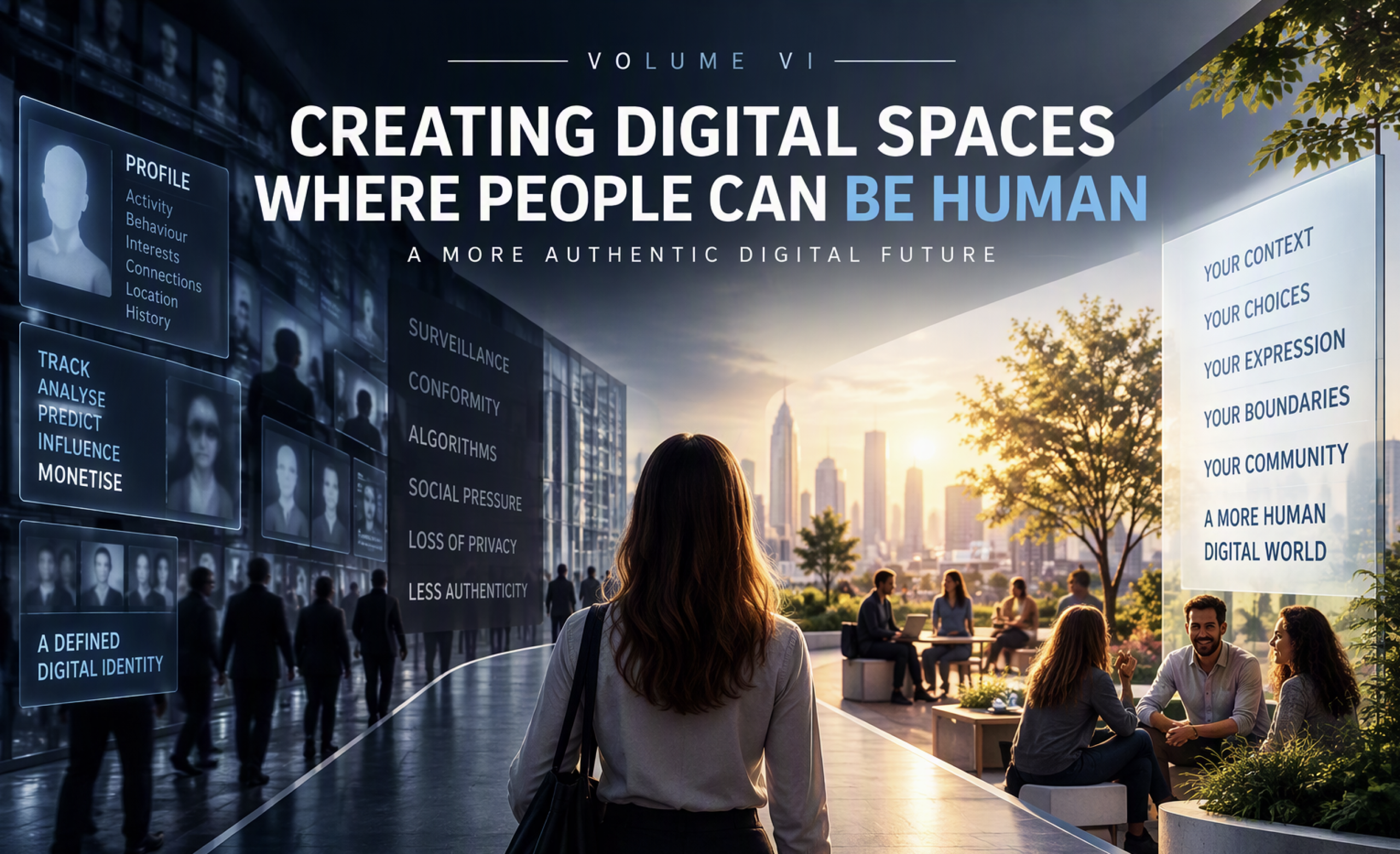
Digital identity was supposed to represent us.
Increasingly, it can also shape us.
- Profiles persist.
- Histories accumulate.
- Interactions become visible.
- Past behaviour follows future behaviour.
- Platforms decide what people see and who sees them.
Over time, people learn that they are not simply participating in a digital environment. They are being observed within it.
And when people know they are being observed, the nature of interaction itself can change.
Volume VI asks a fundamentally human question:
What happens to digital interaction when people no longer need to perform for the systems around them?
From identity as a person to identity as a profile
Most digital platforms construct continuity.
What someone did yesterday becomes part of how that person is understood tomorrow.
Posts, purchases, searches, connections and interactions gradually form increasingly persistent representations of the individual.
The digital profile begins to acquire a life of its own.
For organisations, this may appear useful.
For the individual, however, it raises a different question:
Should everything I have done determine how a system treats me next?
Volume VI explores what changes when identity is no longer treated as a persistent behavioural object.
Creating space for context
People naturally behave differently in different situations.
- We have professional lives.
- Private lives.
- Family relationships.
- Interests.
- Communities.
Conversations that matter only in the moment.
These contexts do not make somebody inconsistent. They are part of being human.
Yet conventional digital identity can collapse these boundaries by creating continuity across contexts.
A different architecture can preserve them.
Instead of forcing every interaction to contribute to one increasingly comprehensive representation of the individual, different contexts can remain meaningfully separate.
That creates an opportunity to design digital environments around context rather than profiling.
For a greenfield organisation
A new platform can ask a very different question from the beginning:
What kind of human behaviour do we want our architecture to make possible?
Not behaviour in the sense of engagement or conversion.
Human behaviour in the sense of expression, interaction, discovery and participation.
If people are not constantly accumulating a behavioural history, they may not need to approach every digital interaction as another contribution to a permanent public or organisational identity.
The architecture can provide space for interaction without requiring that interaction to define the person.
For existing organisations
For established platforms, the question is more challenging.
Persistent profiles, personalisation, reputation mechanisms, behavioural histories and algorithmic recommendations may already be deeply embedded.
Volume VI offers leaders a way to examine the consequences of those mechanisms:
Are we merely representing people’s behaviour, or are our systems beginning to shape the behaviour they subsequently observe?
That distinction matters enormously.
Once a platform influences interaction and then learns from the interaction it helped create, the boundary between observing human behaviour and manufacturing it becomes increasingly difficult to see.
A different relationship between people and platforms
ICCA proposes a different starting point.
Identity can be contextual and temporary rather than an endlessly accumulating profile.
Interaction does not automatically have to create continuity.
And the provider does not need to construct an increasingly detailed model of the individual simply because interactions occur.
The implications extend beyond privacy.
They reach into organisational culture, social interaction, authenticity, power, freedom of expression and the nature of digital communities themselves.
The objective is not anonymity for everything.
Nor is it the removal of accountability where accountability is genuinely required.
It is recognising that not every human interaction needs to become part of a permanent digital identity.
A question for leaders
Look at the digital environments your organisation creates.
Then ask:
Are people behaving naturally within them, or behaving in response to the fact that the system is watching, recording and judging what they do?
And then ask the larger question:
What might people become online if technology stopped trying to define who they are?
That is the adoption question at the heart of Volume VI.
It brings the ICCA journey back to its ultimate purpose: not merely creating different technology, but creating digital environments in which technology provides boundaries within which humans can simply be human.
The underlying ICCA papers are openly shared under a Creative Commons Attribution-ShareAlike 4.0 licence, allowing the principles to be examined, challenged, adapted and developed beyond All Me.
