
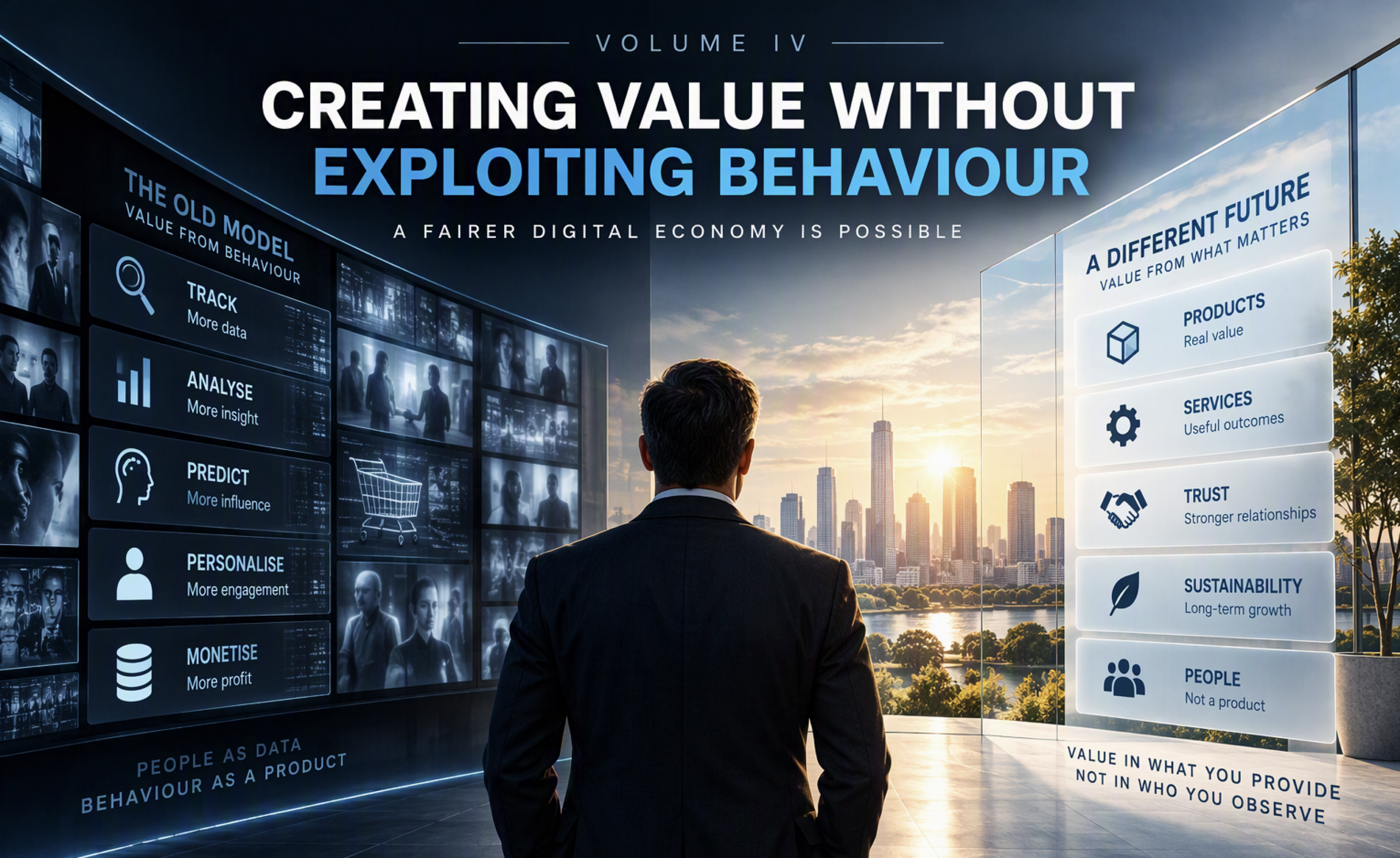
Much of the digital economy has been built around a powerful assumption:
Understanding people’s behaviour creates economic value.
- Observe more.
- Measure more.
- Learn more.
- Predict more.
- Personalise more.
- Influence more.
Over time, information about human behaviour has itself become commercially valuable.
Volume IV asks a fundamentally different question:
What would digital business look like if human behaviour had no commercial value to the provider?
This is more than a privacy proposition.
It potentially changes the basis upon which digital businesses create value.
From people to transactions
Conventional digital models frequently create value around what can be learned about the individual: interests, preferences, previous activity, relationships and likely future behaviour.
ICCA proposes a different starting point.
The economic relationship is centred on what is being exchanged, what rights exist, what obligations must be fulfilled and whether the conditions of the interaction have been satisfied.
The person does not need to become the product surrounding the transaction.
That distinction opens an important strategic conversation.
Could an organisation create successful digital services without creating economic value from knowing progressively more about the people using them?
For a greenfield business
For a new enterprise, this creates an opportunity to establish a very different commercial model from the beginning.
Rather than asking:
How can customer data increase the value of this business?
leaders can ask:
How can the product, service or transaction itself create sufficient value?
That changes where investment goes.
Instead of progressively building systems for behavioural observation, profiling and optimisation, the organisation can concentrate on the value being exchanged.
The proposition to the customer also changes:
Pay for the value you receive rather than subsidising it with information about yourself.
For existing organisations
Established organisations face a more complicated question.
Customer analytics, advertising, recommendations, personalisation, segmentation and behavioural optimisation may already contribute to the commercial model.
The adoption opportunity is therefore not necessarily to remove everything.
It is to understand dependency.
How much of the value created by the organisation comes from the product or service itself, and how much depends upon extracting additional value from knowledge about the customer?
That distinction could become strategically important as expectations around privacy, trust and digital autonomy evolve.
A different competitive proposition
There is also a more provocative possibility.
What if knowing less eventually becomes economically valuable?
An organisation designed around provider blindness could potentially compete on a very different proposition:
We don’t need to understand your behaviour to serve you.
That turns privacy from something managed within the compliance function into part of the commercial relationship itself.
The organisation creates value because customers want its products and services, not because their use creates another asset that can subsequently be analysed or monetised.
Beyond the individual business
This is where Volume IV develops the ICCA argument beyond individual systems.
If behaviour stops being an economically exploitable resource, the implications extend into business models, markets, investment, competition and potentially geographic strategy.
It raises a larger question about the digital economy:
What kind of markets emerge when economic value flows through products, services, rights and obligations rather than the observation of people?
Volume IV explores that possibility.
Its adoption perspective asks leaders to consider not merely whether provider-blind systems are technically possible, but whether they could support viable businesses and ultimately a different digital economy.
The executive question at the heart of the volume is therefore:
Can we create greater economic value by creating less value from people themselves?
The underlying ICCA papers are openly shared under a Creative Commons Attribution-ShareAlike 4.0 licence, allowing the principles to be examined, challenged, adapted and developed beyond All Me.
