
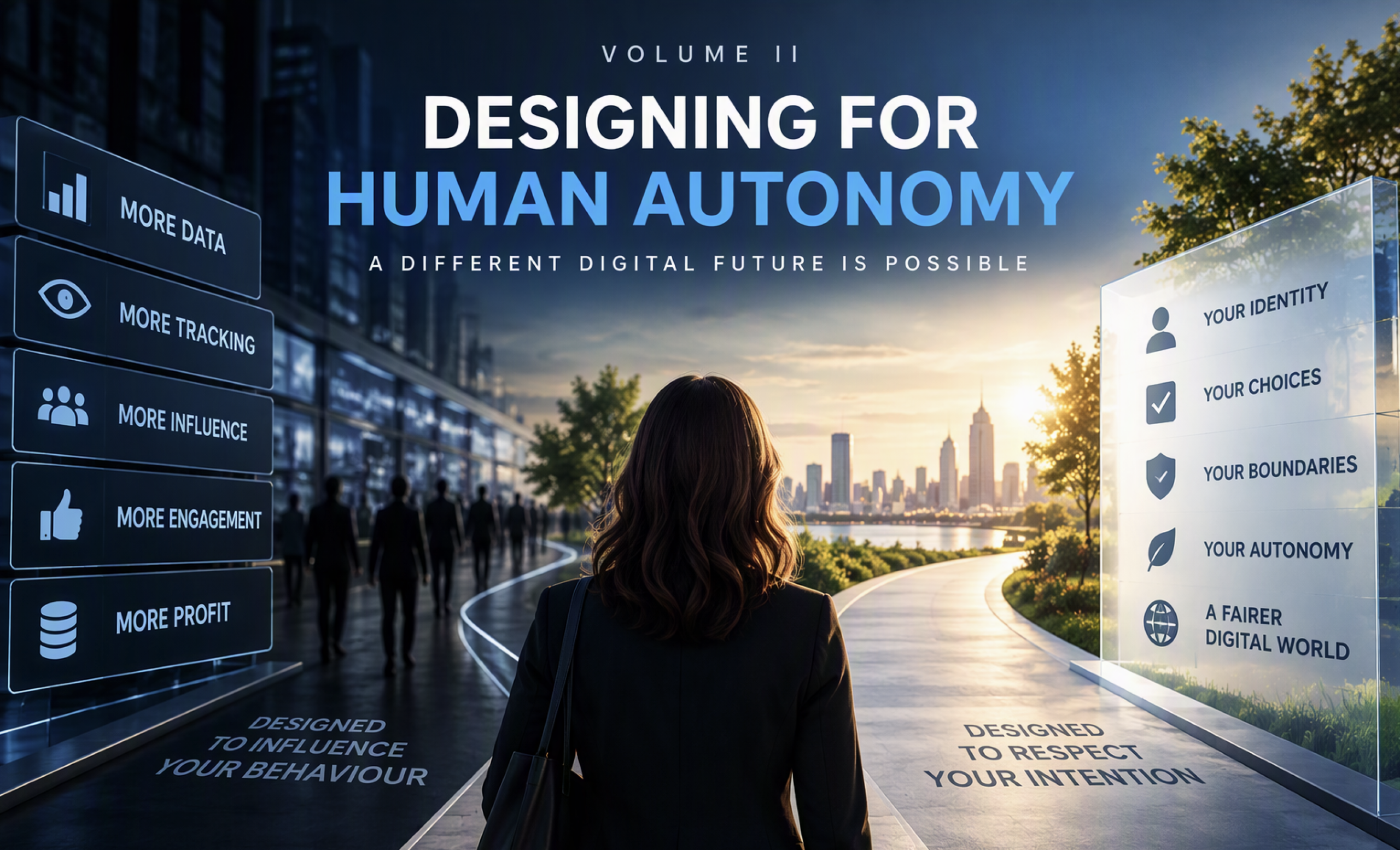
Most digital systems are designed around the needs of the organisation.
They collect information, observe behaviour, measure engagement, create profiles and use what they learn to influence what happens next.
Volume II asks what changes when the individual, rather than the provider, becomes the starting point for design.
The principles in this volume explore a different relationship between people and digital services: one where identity establishes permission, unnecessary information does not accumulate, providers are not automatically able to observe activity, and systems are not designed to exploit behaviour simply because doing so is technically or commercially possible.
For leaders considering a greenfield platform, this provides an opportunity to establish very different foundations from the beginning.
Instead of asking:
What can we know about the customer?
the organisation can ask:
What does the customer actually need us to know?
Instead of building extensive data collection and then surrounding it with privacy controls, governance and policy, the organisation can design boundaries into the system itself.
For existing organisations, the opportunity is different.
Volume II provides a way to examine established assumptions about data, identity, permission, personalisation, engagement and customer behaviour.
It allows leaders to ask where observation genuinely improves a service, where information is actually necessary, and where existing practices persist simply because conventional technology has made them possible.
The potential implications extend beyond privacy.
Adopting these principles could reshape thinking around customer experience, digital trust, data governance, organisational risk, business models, personalisation and the measures organisations use to define digital success.
Most importantly, Volume II introduces a different measure of the relationship between technology and people:
Technology should enable human intention, not manufacture it.
The adoption question at the heart of Volume II is therefore:
What would we build differently if human autonomy were a requirement of the system rather than an aspiration of the organisation?
Volume II explores the structural principles required to make that possible.
Its adoption articles then translate those principles into questions leaders and customers can recognise from everyday digital life, from why organisations require so much information to why technology constantly attempts to influence what people do next.
The underlying ICCA papers are openly shared under a Creative Commons Attribution-ShareAlike 4.0 licence, allowing the principles to be examined, challenged, adapted and developed beyond All Me.
These articles ask questions that matter to everyday users, business leaders, regulators and policymakers:
- Why Do I Have to Give You My Data Before You Give Me a Service?
- Why Does Providing Me a Service Mean You Need to See Me?
- Why Should My Activity Reveal More About Me Than the Interaction Requires?
- Why Should I Have to Trust Your Promises?
- Why Does Saying Yes to One Thing Mean Saying Yes to Everything?
- What If Knowing Less About Me Was Better for Business?
- Why Is Technology Constantly Trying to Influence My Choices?
- What If Watching Me Had No Commercial Value?
- Why Does Everything Online Seem to Want Something From Me?
