
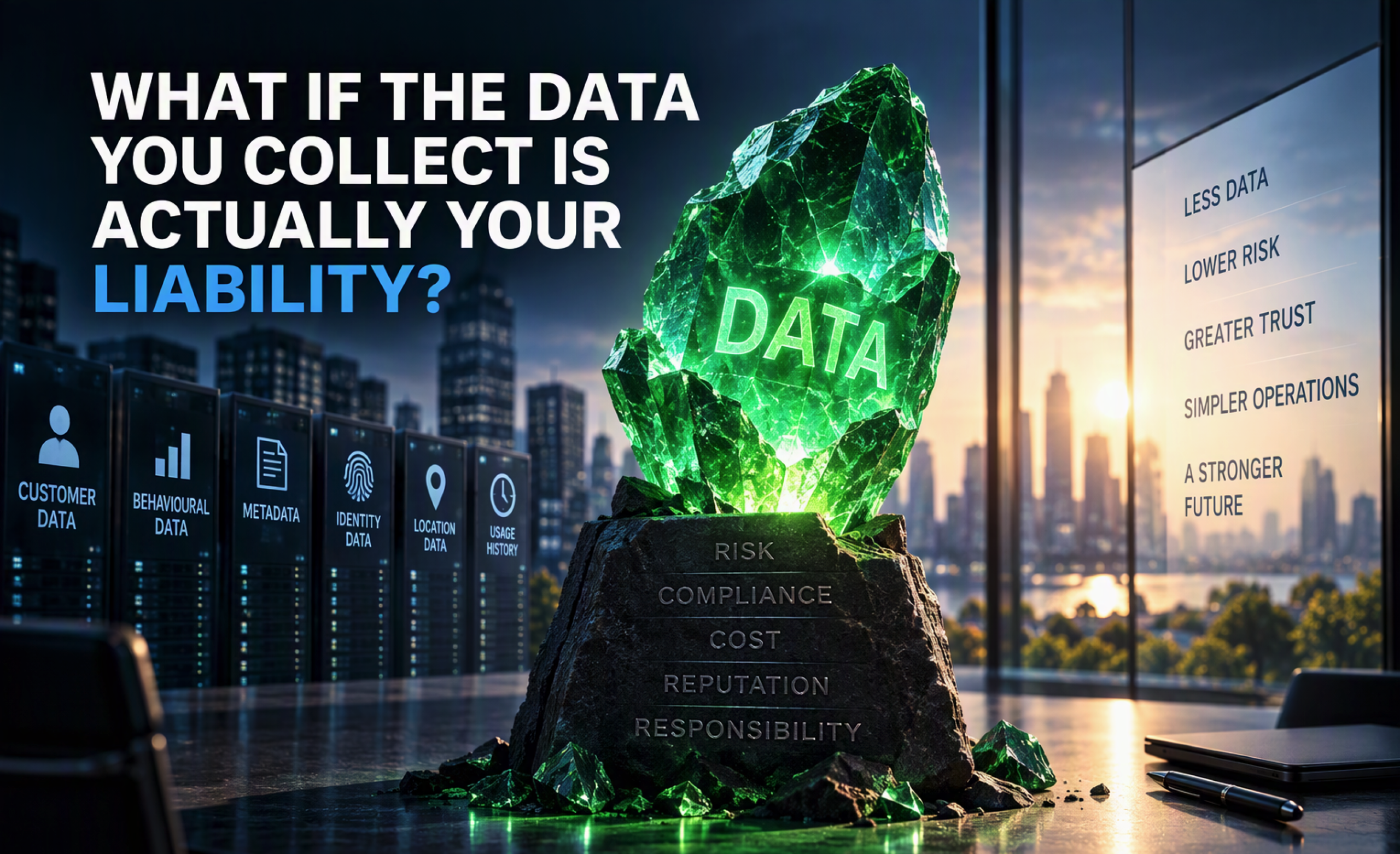
For years, organisations have been told that data is valuable.
- Collect it.
- Store it.
- Analyse it.
- Combine it.
- Use it to understand customers.
- Use it to improve decisions.
- Use it to create competitive advantage.
We have repeated “data is the new oil” so often that possessing more information can almost seem synonymous with building a better digital business.
But there is another way of looking at it.
What if some of the data you collect is not an asset at all?
What if it is kryptonite?
Data isn’t dangerous until you possess it
The kryptonite metaphor is useful because the problem is relational.
Customer data sitting somewhere else is not your organisational responsibility.
The moment your organisation collects it, everything changes.
- You now have something to protect.
- Something to govern.
- Something whose use may need to be justified.
- Something employees, suppliers or systems may be able to access.
- Something an attacker might want.
And something whose loss or misuse could have consequences for both the customer and the organisation.
Possession creates responsibility.
That changes the economic equation.
The invisible cost of knowing
Imagine discovering tomorrow that your organisation could deliver exactly the same customer service while holding substantially less information about the people using it.
Would you still choose to collect everything you collect today?
Perhaps.
Some information genuinely creates value or is necessary to fulfil an obligation.
But other information may exist simply because digital systems make collecting it easy.
That distinction matters.
Because data does not sit silently inside an organisation without consequence.
It creates systems.
- Security.
- Governance.
- Processes.
- Controls.
- Responsibilities.
The conversation therefore should not only be:
What value can we get from this information?
It should also be:
What responsibility do we acquire by possessing it?
For a greenfield business
A new business has an opportunity established organisations rarely had.
It can ask the question before information begins accumulating.
Not:
What data can we capture?
But:
What information do we genuinely need in order to provide this service?
Everything else has to justify its existence.
That can produce a profoundly different technology estate and operating model.
Instead of collecting information and subsequently spending money protecting it, the organisation starts by questioning why it should possess it at all.
For existing organisations
For an established organisation, the opportunity is different.
Nobody is going to remove decades of systems, customer records and processes overnight.
But leaders can begin examining their information estate through a different lens.
For every category of customer information, ask two questions:
What value does possessing this create?
and
What responsibility does possessing this create?
The interesting cases are where the second begins to outweigh the first.
Those may be the places where data has quietly moved from asset to liability.
The customer’s experience matters too
There is another side to this discussion.
Customers interact with the experience they can see.
- A website.
- An app.
- A purchase.
- A message.
- A subscription.
They may have little understanding of the information generated behind those apparently simple interactions.
That creates an important question about trust.
If customers understood everything an ordinary interaction caused your organisation to learn about them, would they still consider the exchange reasonable?
Compliance alone cannot answer that question.
It is a question about the relationship you have chosen to create with the customer.
What if the safest data is the data you never had?
Most cybersecurity strategies understandably focus on protecting information.
- Better security.
- Better controls.
- Better detection.
- Better governance.
- All remain important.
But architecture introduces another possibility:
Don’t possess unnecessary information in the first place.
You cannot lose what you never collected.
You cannot misuse what you cannot access.
You don’t have to govern information that does not exist within your organisation.
This is where the adoption implications of ICCA for Consumers: Data as Kryptonite become much broader than consumer privacy.
It becomes an executive question about risk, cost, responsibility and organisational design.
A question for leaders
Look at the information your organisation currently possesses about customers.
Then ask:
If we were building this business today, would we deliberately choose to collect every piece of it?
If the answer is no, perhaps the most valuable data strategy isn’t figuring out how to collect more.
Perhaps it is determining what you can afford not to know.
That is the adoption question behind ICCA for Consumers: Data as Kryptonite.
The underlying ICCA work is openly shared under a Creative Commons Attribution-ShareAlike 4.0 licence, encouraging discussion, challenge, adaptation and further development.
The paper explores how data became dangerous. This article asks executives to consider something simpler: when does possessing information stop being an advantage and start becoming a liability?
#ICCA #DataStrategy #DataRisk #Leadership #CyberRisk #DigitalTrust #DataGovernance #PrivacyByDesign #DigitalTransformation #CreativeCommons
