
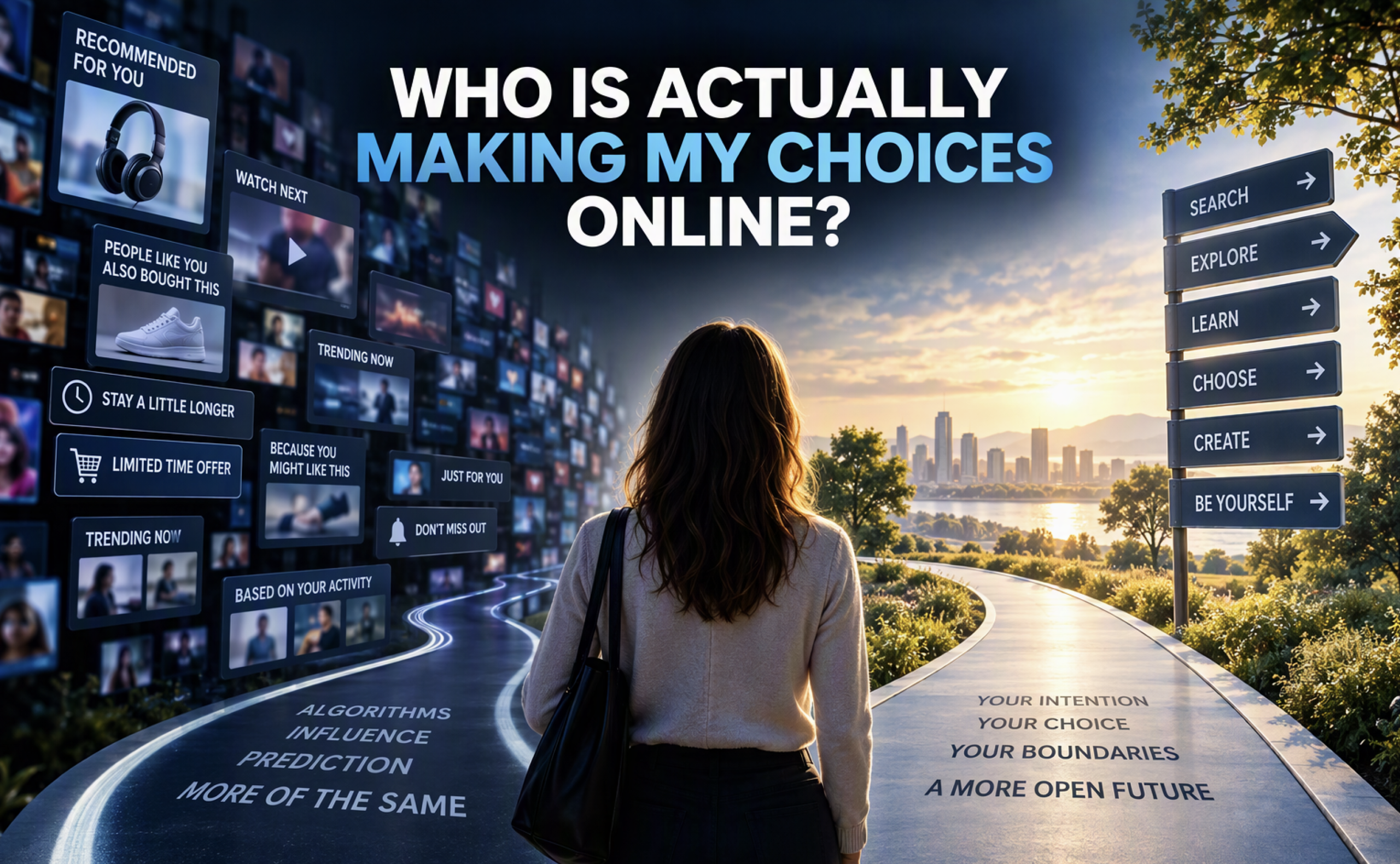
We like to believe we are making our own choices online.
- What to read.
- What to buy.
- Who to follow.
- What to watch.
- Where to go next.
And technically, we are.
- We click the button.
- We make the purchase.
- We select the content.
But increasingly, something else happens before we make that choice.
The system decides what choices to put in front of us.
Choice is not the same as autonomy
Open almost any digital platform and the experience has already been shaped.
- Products have been ranked.
- Content has been selected.
- Recommendations have been generated.
- Notifications have been prioritised.
- Search results have been ordered.
- Offers may have been personalised.
None of those things individually removes our ability to choose.
But they raise a more interesting question:
How autonomous is a choice when someone else controls the environment in which that choice is made?
That distinction matters.
Consumer choice asks whether I can select between the options presented to me.
Consumer autonomy asks something deeper:
Who determined the options, and why?
When understanding the customer becomes influencing the customer
Organisations understandably want to understand customers.
Better understanding can help create better products and experiences.
But digital systems have enabled something beyond understanding.
They can use what they learn about an individual to change the environment presented to that individual.
What I did yesterday might influence what I see today.
What I clicked may influence what I am offered next.
What people considered similar to me did may influence what the system believes I should do.
At that point, observation and influence begin to form a loop:
- Observe.
- Predict.
- Present.
- Measure the response.
- Adjust.
The individual remains free to choose.
But the environment surrounding that choice is increasingly constructed by the provider.
What if the system didn’t know enough to influence me?
This is where provider blindness creates an interesting possibility.
If a provider cannot construct a persistent behavioural model around an individual, then the ability to personalise influence around that model disappears with it.
The system can still provide choices.
- It can still enable search.
- It can still organise information.
- It can still help people navigate complexity.
But something fundamental changes:
The person’s previous behaviour no longer needs to determine the environment presented to them next.
Discovery can begin with the individual’s intention rather than the provider’s prediction.
For a greenfield business
This creates a very different product-design question.
Instead of asking:
How do we optimise the customer journey?
leaders can ask:
How do we give the customer the clearest possible environment in which to make their own journey?
Those questions sound similar.
They can produce profoundly different products.
One attempts to improve the path the organisation would like the individual to take.
The other improves the person’s ability to choose a path for themselves.
That is the difference between optimising behaviour and enabling autonomy.
For existing organisations
Established organisations face a harder question.
Recommendation systems, personalisation, targeting, behavioural analytics, engagement and conversion optimisation may all be embedded within existing digital experiences.
The useful question is not whether all of those practices should disappear.
It is whether leaders understand where assistance ends and influence begins.
Ask:
Does this feature help the customer accomplish something the customer wants to accomplish?
Then ask:
Or does it primarily help us encourage the customer towards an outcome we want?
Sometimes the interests will align.
Sometimes they may not.
Recognising the distinction is the beginning of an autonomy discussion.
Autonomy changes how we measure success
This may have significant implications for leadership.
Digital success is commonly measured through outcomes such as engagement, retention and conversion.
But consider another measure:
Did the person accomplish what they intended to accomplish?
Someone who enters a digital service, finds exactly what they need and leaves five minutes later may appear poorly engaged.
From the individual’s perspective, the experience may have been perfect.
That exposes an important difference between platform success and human success.
Consumer autonomy asks organisations to consider both.
From customer journey to customer agency
We often talk about designing customer journeys.
There is something revealing in the phrase itself.
Whose journey is it?
If it belongs to the customer, perhaps the organisation should not always determine where it leads.
- The organisation can create the environment.
- Provide the tools.
- Establish safe boundaries.
- Make information accessible.
- Remove unnecessary friction.
- But ultimately:
The system facilitates.
The person decides.
A question for leaders
Look at your organisation’s digital customer experience and ask:
How much of it helps customers make their own decisions, and how much is designed to make their decisions more predictable to us?
Then ask the harder question:
If we could no longer profile individual behaviour, would we still know how to create a compelling customer experience?
That is the adoption question behind ICCA and Consumer Autonomy.
It is not an argument against good design, recommendations or helpful technology.
It asks something more fundamental:
Should the objective of intelligent technology be to become better at influencing people, or better at enabling people to act for themselves?
The underlying ICCA work is openly shared under a Creative Commons Attribution-ShareAlike 4.0 licence, encouraging discussion, challenge, adaptation and further development.
Perhaps the ultimate measure of a human-centred digital system is not how successfully it predicts what people will do next, but how little it needs to.
#ICCA #ConsumerAutonomy #HumanAutonomy #DigitalTrust #CustomerExperience #BehaviouralNeutrality #EthicalTechnology #Leadership #HumanCentredDesign #CreativeCommons
