
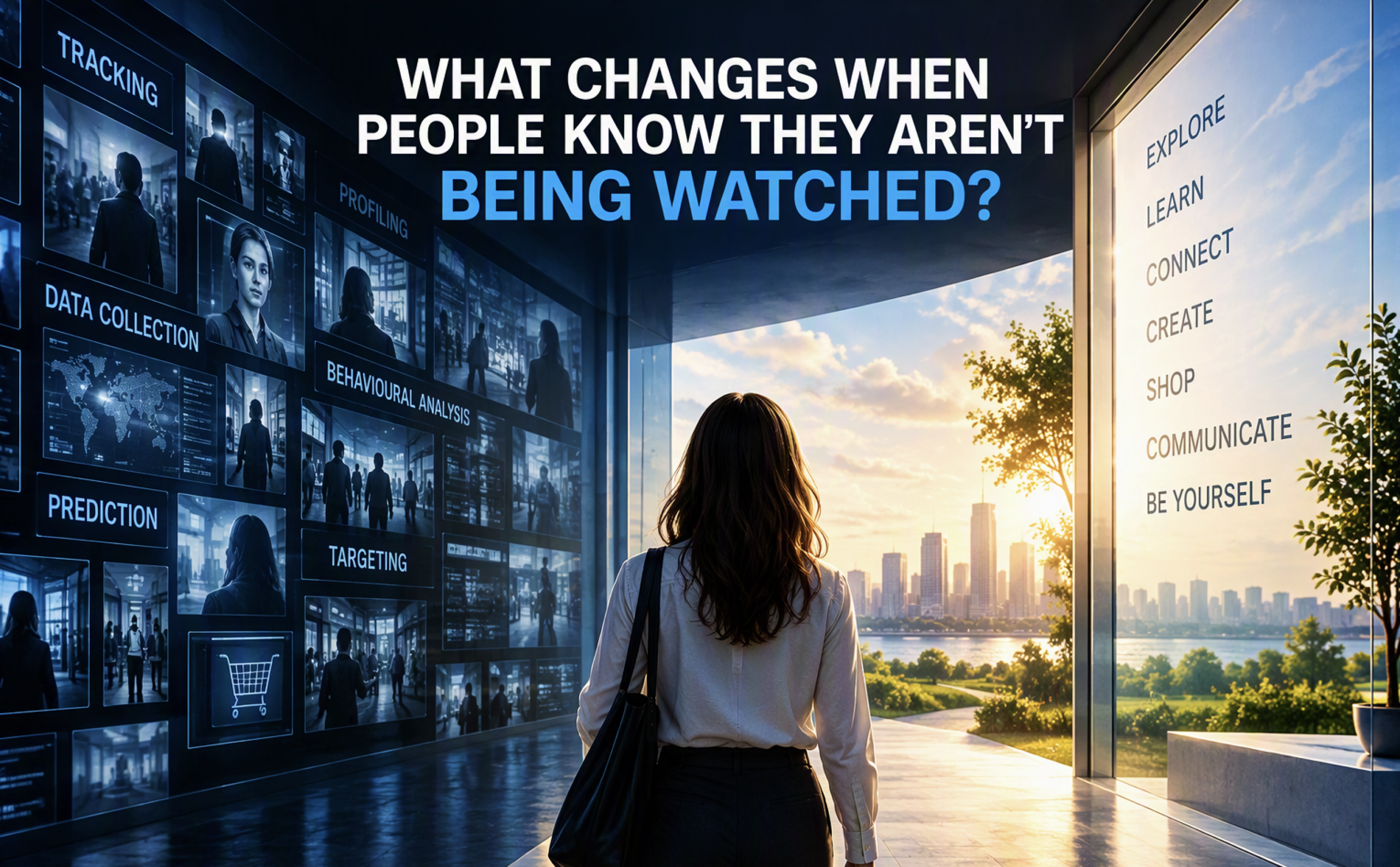
We know digital systems observe us.
We see the cookie banners.
We accept the permissions.
We notice an advert for something we searched for yesterday.
We watch recommendations change as platforms learn what interests us.
Most of the time, we carry on.
But knowing that observation exists changes the relationship.
Perhaps not dramatically.
Perhaps not consciously.
But there is a fundamental difference between entering a space where an interaction simply happens and entering one where the interaction may become part of a permanent record.
And that raises an important question:
Does knowing we are being watched change how we behave?
Observation changes the environment
Consider the physical world.
There are places where observation is reasonable and expected.
- Airports.
- Banks.
- Secure facilities.
There are other places where constant observation would feel entirely unnecessary.
- A private conversation.
- Browsing in a bookshop.
- Reading a newspaper.
- Walking through a park.
The context determines whether observation seems proportionate.
Digital environments have blurred those distinctions.
Browsing, reading, messaging, shopping and searching can all produce information about the person behind the activity.
Observation has gradually become part of the environment itself.
When observation becomes normal
The interesting issue is not simply whether organisations misuse information.
An organisation may behave entirely responsibly.
The deeper question is what happens when people know that their actions can be recorded, connected and interpreted.
A search is no longer necessarily just a search.
A click may become evidence of interest.
A purchase may contribute to a profile.
An interaction may influence what appears later.
The individual begins interacting not only with the service but with an invisible understanding that:
The system may remember this.
That changes the nature of the digital space.
What would it mean not to be observed?
Imagine knowing that an ordinary digital interaction could not become part of a behavioural profile.
Not because the organisation promises not to create one.
Not because a setting has been disabled.
Not because the information will eventually be deleted.
But because the system has been designed without the visibility required to construct it.
The relationship changes.
The person no longer needs to consider what the provider might infer from the interaction.
The interaction can simply be the interaction.
For a greenfield business
This creates an unusual design opportunity.
When building a new service, leaders can ask:
Does this interaction genuinely require observation?
Rather than automatically creating visibility and subsequently introducing privacy controls, the organisation can decide where visibility should exist in the first place.
Some activities may legitimately require accountability.
Others may not.
The important thing is recognising the distinction.
This changes privacy from a control surrounding the customer experience into something that helps define the experience itself.
For existing organisations
Established businesses face a more complicated situation.
Analytics, personalisation, fraud prevention, marketing and performance measurement may depend upon different forms of visibility.
The practical question is therefore not:
Can we stop observing everything tomorrow?
It is:
Where is observation genuinely necessary, and where has it simply become the default?
That creates an opportunity to examine the customer journey differently.
For every point where information is generated, leaders can ask whether the visibility creates sufficient value to justify the relationship it creates with the customer.
Trust is not the whole problem
Organisations often respond to customer concerns by trying to increase trust.
- Better explanations.
- Clearer privacy policies.
- More controls.
- Greater transparency.
- Those things can help.
- But they do not change the underlying relationship.
- The organisation can still observe.
The individual still has to decide whether to trust what happens next.
Provider blindness introduces another possibility:
Remove unnecessary observation rather than continually reassuring people about it.
That is a profoundly different proposition.
From privacy to freedom of interaction
This is where ICCA and Surveillance Anxiety becomes bigger than a privacy discussion.
The question is not simply:
Who can see my information?
It is:
How does knowing that I can be observed affect the way I participate?
If observation disappears where it is unnecessary, something else becomes possible.
Browsing can simply be browsing.
Discovery can simply be discovery.
Conversation can simply be conversation.
People no longer need every ordinary interaction to become another contribution to an accumulating digital representation of themselves.
A question for leaders
Look at the digital environment your organisation provides and ask:
How would customers use this service differently if they knew their ordinary activity could not be used to construct a profile of them?
Then ask the more difficult question:
Where does observation improve the customer’s experience, and where does it primarily improve our understanding of the customer?
Those are not necessarily the same thing.
That is the adoption question behind ICCA and Surveillance Anxiety.
The paper examines the human consequences of digital observation.
The leadership question is more direct:
What kind of relationship with customers becomes possible when people no longer have to wonder who is watching?
The underlying ICCA work is openly shared under a Creative Commons Attribution-ShareAlike 4.0 licence, encouraging discussion, challenge, adaptation and further development.
Perhaps the most significant consequence of provider blindness is not what the organisation stops seeing. It is what the individual becomes free to stop thinking about.
#ICCA #Surveillance #DigitalTrust #HumanAutonomy #PrivacyByDesign #CustomerTrust #DigitalWellbeing #Leadership #DigitalTransformation #CreativeCommons
