Most organisations talk about becoming more agile while leaving their fundamental organisational structure unchanged.
The hierarchy remains. Management remains. Job descriptions remain. Individual performance targets remain. Compensation remains differentiated by level. Strategic priorities are set at the top and translated into work for teams below.
Agile is then introduced primarily at the delivery layer.
All me is taking a different approach.
Its planned post-launch organisational structure is designed around the proposition that Agile should not simply describe how teams deliver work. It should describe how the organisation governs itself.
The result is an organisation built around autonomy, transparency, collective prioritisation, equal participation and continuous adaptation.
The organisation is the team
At All me, the concept of “the team” is deliberately broad.
The team is everyone in the organisation.
There is no separate privileged delivery group operating beneath a conventional management structure. Contributors participate as independent professionals, but they are part of the same organisational system and have visibility of the work and impact of their colleagues.
This changes the fundamental unit of organisational design.
Rather than:
Leadership → management → teams → individuals
the model is closer to:
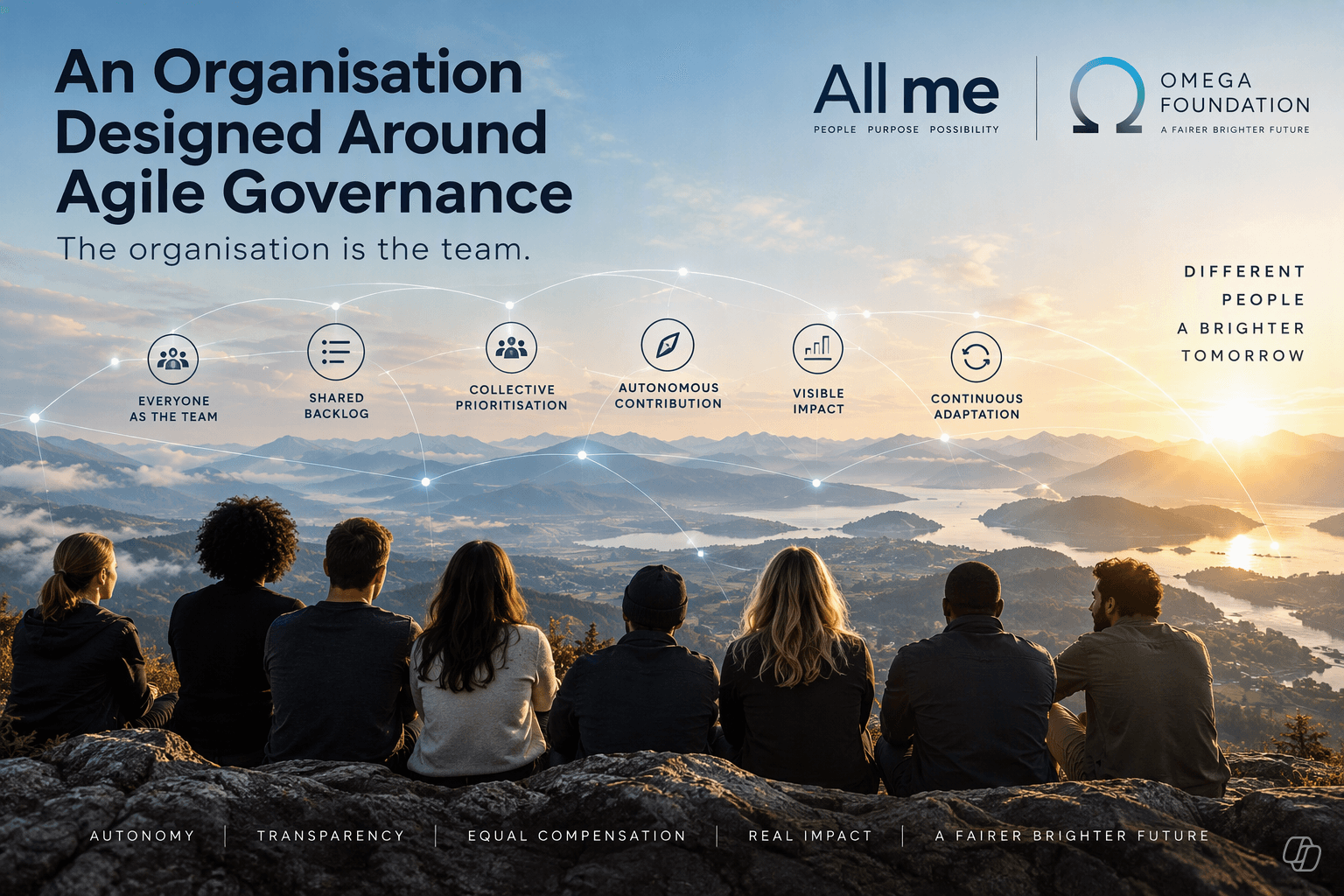
People → shared purpose → shared backlog → collective prioritisation → autonomous contribution
Coordination therefore does not depend primarily upon managerial instruction.
Independent contributors rather than conventional employment
All me uses a retainer model rather than traditional employment.
Contributors remain independent professionals. Retainers are month-to-month, allowing people to maintain other professional commitments, work with other organisations and develop their own products or ventures.
This is not intended to create a conventional contractor hierarchy.
Instead, the retainer provides a mechanism for maintaining an ongoing relationship with the ecosystem while preserving professional autonomy.
There is also no conventional expectation that contribution means exclusivity.
The principal restriction is a deliberately narrow non-compete intended to protect All me’s ecosystem, confidential knowledge and architecture from direct competitive replication.
The underlying principle is simple:
Independence is the default; restriction is the exception.
Equal compensation
One of the most distinctive features of the model is its approach to compensation.
Everyone receives the same amount.
That includes the founder.
This removes a significant source of hierarchy from the organisational system. People are not competing internally for higher salaries, management grades or increasingly senior compensation bands.
Equal compensation does not mean equal contribution. People can contribute in very different ways.
Instead, it separates economic reward from organisational status.
The question becomes less about who occupies the highest-paid position and more about where each person can create the greatest value.
The founder is part of the same economic system
The founder receiving the same retainer as everyone else is particularly significant.
In a conventional organisation, the founder generally sits at the top of the economic hierarchy. Their authority is reinforced by ownership, title and compensation.
All me deliberately removes at least one of those distinctions.
The founder remains a source of vision, experience and organisational knowledge, but does not receive a higher retainer simply because of that position.
This is consistent with the wider principle that authority should come from contribution, knowledge and the ability to create value rather than from organisational rank alone.
A shared organisational backlog
Instead of each department maintaining its own priorities, All me uses a central backlog.
The backlog represents the needs, opportunities, problems and insights requiring attention across the ecosystem.
Anyone can contribute to it.
This creates organisational transparency: people can see what the organisation believes needs attention rather than relying upon information flowing through layers of management.
The backlog therefore becomes more than a project-management tool.
It becomes part of the organisation’s governance infrastructure.
Collective prioritisation
Each week, the organisation participates in priority voting.
The purpose is not simply to decide which development ticket should be completed next.
The mechanism determines where collective organisational attention should go.
That is an important distinction.
Traditional organisations normally resolve competing priorities through hierarchical escalation. A manager decides, or a chain of managers decides.
All me instead intends to make prioritisation a collective process.
The organisation can therefore continually adjust its attention as circumstances, customer needs and ecosystem requirements change.
Autonomous execution
Once priorities are established, contributors self-direct their work.
There are no rigid task lists prescribing exactly what every individual must do.
People determine where their expertise can create the greatest value against the agreed priorities.
This produces a different relationship between governance and execution:
Governance establishes shared direction.
Individuals determine how they can best contribute to that direction.
The intention is to preserve autonomy without sacrificing organisational coherence.
Impact rather than activity
All me also changes the way contribution is assessed.
The model does not rely on conventional surveillance-based performance management, rigid KPIs or lists of completed tasks.
Instead, the team has visibility of everyone’s impact on a monthly basis.
Contribution is considered through factors such as:
impact on the platform;
collaboration;
quality of insight;
initiative;
contribution to the wider ecosystem.
This creates an important feedback loop.
Weekly prioritisation asks:
What should we focus on?
Monthly impact visibility asks:
What difference did our contribution make?
The organisation can then adapt.
A deliberately small operational function
Although the organisation is highly decentralised, decentralisation does not mean the absence of support.
Around 10% of the organisation is allocated to HR and vendor contracts, with a focus on delivery and wellbeing.
This is an important distinction.
The function exists to support the system rather than to create a conventional managerial layer above it.
It provides the infrastructure required for people to participate effectively while preserving the autonomy of the wider organisation.
The organisational design therefore separates support and enablement from command and control.
Continuous organisational adaptation
The month-to-month retainer model, weekly priority voting and monthly impact visibility create multiple feedback cycles.
The organisation can continually ask:
What matters now?
Where can people create the most value?
What impact are we actually having?
What needs to change?
This is fundamentally different from an organisation that establishes annual objectives and then manages people against them for twelve months.
The organisation itself becomes an adaptive system.
Agile beyond delivery
This is where the model connects most directly to the broader Agile tradition.
Agile is frequently implemented today as a delivery methodology.
Teams may use Scrum, Kanban, iterative planning, retrospectives and continuous delivery while operating inside a conventional hierarchy.
The delivery process changes.
The governance system does not.
All me is attempting something broader.
Its organisational model applies principles associated with Agile and Lean to:
governance;
prioritisation;
organisational membership;
compensation;
accountability;
decision-making;
work allocation;
performance feedback;
organisational support.
In this model, Agile is not something that happens inside the organisation.
The organisation itself is designed to operate according to Agile principles.
From hierarchy to a network
The resulting structure is better understood as a network than a traditional hierarchy.
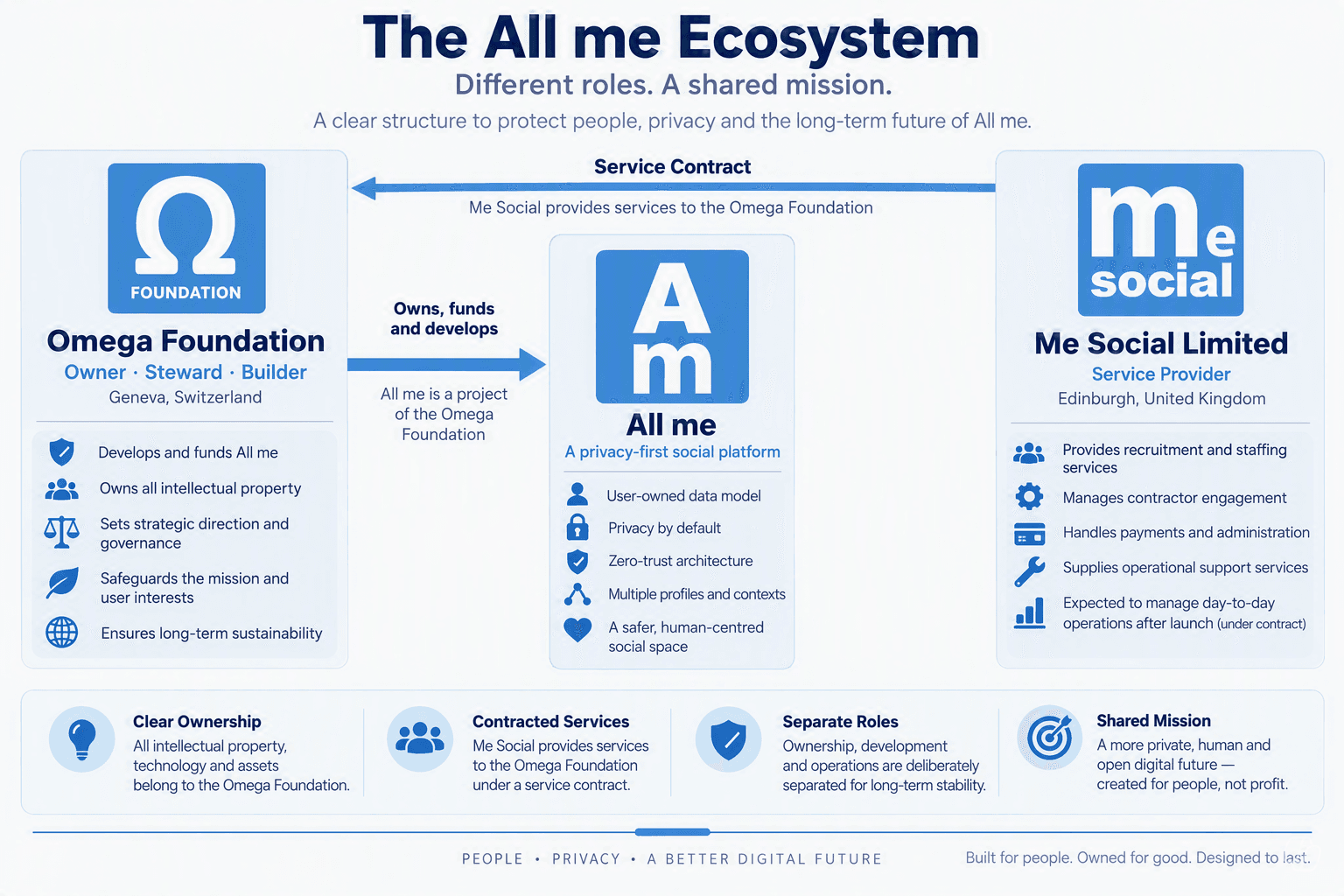
There is still a legal and operational entity. Me Social Limited manages onboarding, retainer agreements and fee processing.
But the existence of a legal entity does not require the internal operating model to reproduce conventional corporate hierarchy.
The organisation can therefore retain the necessary legal and operational infrastructure while distributing decision-making and autonomy across its contributors.
The structure becomes:
Legal entity
↓
Shared organisational infrastructure
↓
Everyone as the team
↓
Shared backlog
↓
Collective prioritisation
↓
Autonomous contribution
↓
Visible impact
↓
Continuous adaptation
That is a fundamentally different organisational architecture from the conventional corporation.
The underlying proposition
The most interesting aspect of All me’s structure is therefore not any single policy.
It is the fact that the policies reinforce one another.
Equal compensation supports reduced hierarchy.
Monthly retainers support independence.
Independence supports self-direction.
Self-direction requires transparent priorities.
The shared backlog provides those priorities.
Collective voting determines organisational attention.
Monthly impact visibility provides feedback.
The HR and vendor function supports the people and infrastructure required to keep the system working.
The non-compete protects the ecosystem without imposing broad exclusivity.
Together, these mechanisms form a coherent operating model.
From managing people to designing a system
The traditional organisation asks:
How should we manage our people?
The All me model asks a different question:
How should we design the system so that capable people can organise themselves around creating value?
That is a significant change in organisational philosophy.
The objective is not to eliminate coordination.
It is to achieve coordination without making hierarchy the primary mechanism.
It is not to eliminate accountability.
It is to make impact visible to the whole team rather than relying exclusively on managerial assessment.
It is not to eliminate leadership.
It is to separate leadership from permanent organisational privilege.
And it is not to eliminate structure.
It is to replace rigid structure with an adaptive governance system.
An organisational experiment
The significance of All me therefore lies beyond its use of retainers or its rejection of traditional employment structures.
It represents an attempt to take Agile’s underlying ideas out of the delivery team and apply them to the organisation as a whole.
That makes All me, in effect, an experiment in Agile organisational governance.
Its success will ultimately depend on whether collective prioritisation can remain effective as the organisation grows, whether equal compensation continues to support rather than undermine contribution, whether autonomy produces sufficient coordination, and whether transparent impact can provide enough accountability without recreating managerial hierarchy.
Those are not small questions.
They are precisely the questions that arise when Agile stops being a methodology for delivering products and becomes a philosophy for designing organisations.
All me is attempting to make the organisation itself the Agile system.