
Every organisation wants attention.
Without attention, customers cannot discover a product.
They cannot understand an offer.
They cannot use a service.
They cannot make a decision.
So attracting attention is a perfectly reasonable business objective.
But there is another question.
Once we have someone’s attention:
What responsibility do we have for what we do with it?
That question is becoming increasingly important because digital services do not simply compete for money.
They compete for something much more limited.
Human attention.
Attention is not an unlimited resource
A customer has a finite amount of time.
A finite capacity to concentrate.
A finite number of decisions they can comfortably make.
And a finite willingness to deal with interruptions.
Yet a customer may encounter dozens of organisations simultaneously asking for attention.
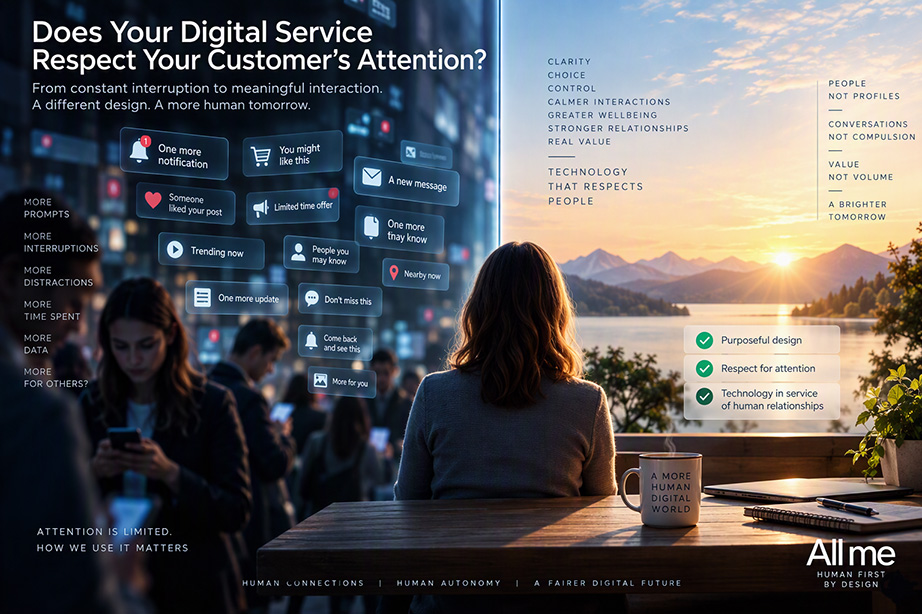
- Read this.
- Look at this.
- Respond to this.
- Don’t forget this.
- You might like this.
- Someone has done this.
- Something has changed.
- Come back and see this.
Individually, none may seem particularly significant.
Collectively, they create an environment in which everybody wants a small piece of the customer’s attention.
The problem is that nobody sees themselves as responsible for the whole.
When attention becomes a business metric
Imagine the executive dashboard.
- Time spent.
- Engagement.
- Return frequency.
- Click-through.
- Notifications opened.
- Content viewed.
- Interactions completed.
These measures can tell an organisation useful things.
But there is a potential conflict hidden inside them.
If success increases when customers spend more time interacting with the organisation, what incentive does the organisation have to help customers spend less?
If another notification creates another visit, what incentive exists not to send it?
If another recommendation creates another interaction, why stop recommending?
The organisation may never consciously decide to consume more of the customer’s attention.
It can emerge naturally from what the organisation chooses to measure.
The customer may have a different objective
This creates an interesting difference between the organisation and the customer.
The organisation may want:
More interaction.
The customer may want:
To get something done.
Those objectives can align.
But they do not always align.
Imagine opening an application to complete something that should take three minutes.
You complete it.
From your perspective, the experience has been successful.
But the service has another recommendation.
Another notification.
Another opportunity.
Another piece of content.
Another suggested action.
The organisation may regard each additional interaction as valuable.
The customer may simply want to leave.
Who should determine when the interaction has finished?
When good design knows when to stop
We normally think of good customer experience as helping people accomplish things.
- Make the journey easier.
- Reduce unnecessary steps.
- Remove friction.
- Explain things clearly.
- Help the customer reach the outcome.
There is an obvious conclusion to that philosophy which digital businesses sometimes overlook:
Once the customer has achieved the outcome, perhaps the experience should be allowed to end.
No additional prompt.
No artificial urgency.
No attempt to generate another interaction simply because another interaction improves a measure.
Just:
Done.
That can be excellent customer experience.
Cognitive safety should be a leadership question
We regularly discuss physical safety.
We increasingly discuss psychological safety at work.
We discuss financial vulnerability.
We discuss data protection.
Perhaps organisations should also be discussing cognitive safety.
The underlying concept is straightforward.
Is the digital environment we provide respectful of the customer’s ability to think, decide and direct their own attention?
The published ICCA Design Principles: Cognitive Safety and Non‑Compulsive Interaction defines cognitive safety in terms of digital systems not manipulating attention, amplifying emotion or creating compulsive loops.
This need not begin as a technical conversation.
It can begin in the boardroom.
Nobody needs to intend harm
This is important.
An organisation does not need to deliberately set out to exhaust or manipulate customers.
Consider a sequence of perfectly understandable decisions.
Marketing wants better response rates.
Product wants greater engagement.
Commercial wants more conversions.
Customer experience wants greater retention.
Digital wants more active users.
Each team is attempting to improve its own outcome.
But the customer experiences the combined effect.
The customer does not experience five departmental objectives.
The customer experiences:
Another interruption.
Another prompt.
Another reason to respond.
Another demand on attention.
That makes cognitive safety an organisational design question as much as a digital design question.
For a greenfield business
A new organisation can make a different decision from the beginning.
It can ask:
How much of our customer’s attention do we actually need?
That is a very different question from:
How much attention can we capture?
It can decide that success means helping customers achieve an outcome rather than maximising time spent achieving it.
It can treat customer attention as something borrowed rather than something acquired.
It can design for:
- Clarity.
- Simplicity.
- Purpose.
- Choice.
- Completion.
- Trust.
And perhaps most unusually:
An obvious place to stop.
That can become part of the proposition itself.
For existing organisations
Established organisations face a harder challenge.
Mechanisms designed to stimulate interaction may already be embedded across the business.
- Notifications.
- Recommendations.
- Personalisation.
- Promotions.
- Reminders.
- Engagement targets.
- Retention targets.
- Conversion targets.
The objective does not need to be removing them.
The objective is understanding their cumulative effect.
Leadership can ask:
Which interactions genuinely help the customer?
Which simply help one of our measures?
Which interruptions are necessary?
Which exist because they produce a measurable response?
And importantly:
Who inside the organisation is responsible for understanding the combined cognitive demand we place on the customer?
If the answer is nobody, that itself may be useful information.
What if calm became a competitive advantage?
Digital businesses have spent years competing for attention.
Perhaps there is another way to compete.
Imagine a service customers trust because it does not unnecessarily interrupt them.
A service that does not create artificial urgency.
A service that does not continually demand another interaction.
A service that allows customers to concentrate on what they came to accomplish.
A service comfortable with silence when there is genuinely nothing useful to say.
That could initially appear commercially counterintuitive.
But consider what the organisation would be communicating:
We value your attention enough not to waste it.
That is a relationship built around respect.
And respect can create trust.
The business model matters
There is a deeper issue underneath all of this.
If revenue increases primarily when customers spend more time, see more things, generate more interactions or provide more behavioural information, then reducing unnecessary interaction may conflict with the business model.
That should not automatically make the business model wrong.
But leadership should recognise the incentive it creates.
Because design teams cannot resolve a conflict that originates in corporate economics.
If the business earns more when people remain engaged for longer, asking designers to protect people’s attention while simultaneously maximising engagement places two objectives in competition.
The leadership question therefore becomes:
Which objective takes precedence when customer autonomy and organisational performance point in different directions?
That requires an executive answer.
A question for leaders
Look at your digital services.
Look at every notification, recommendation, reminder, prompt and engagement mechanism.
Then ask:
If this disappeared, would the customer lose something valuable?
If the answer is yes, there may be a strong reason for it to exist.
If the answer is no, ask another question:
Why are we asking for the customer’s attention?
Then consider the bigger question:
Are we measuring the value customers receive from our digital service, or the amount of attention we successfully extract from them?
Those are not the same measure of success.
That is the adoption question behind ICCA Design Principles: Cognitive Safety and Non‑Compulsive Interaction. The underlying paper asks how digital environments can support calm, autonomous and non-manipulative interaction rather than systems built around compulsive loops.
The underlying ICCA work is openly published, with the source listing a CC BY 4.0 licence.
Perhaps the next competitive advantage in digital experience will not come from becoming better at capturing attention.
Perhaps it will come from becoming the organisation customers trust to give their attention back.
#ICCA #CognitiveSafety #CustomerAttention #HumanAutonomy #DigitalWellbeing #CustomerExperience #ResponsibleTechnology #DigitalTrust #EthicalDesign #Leadership
