
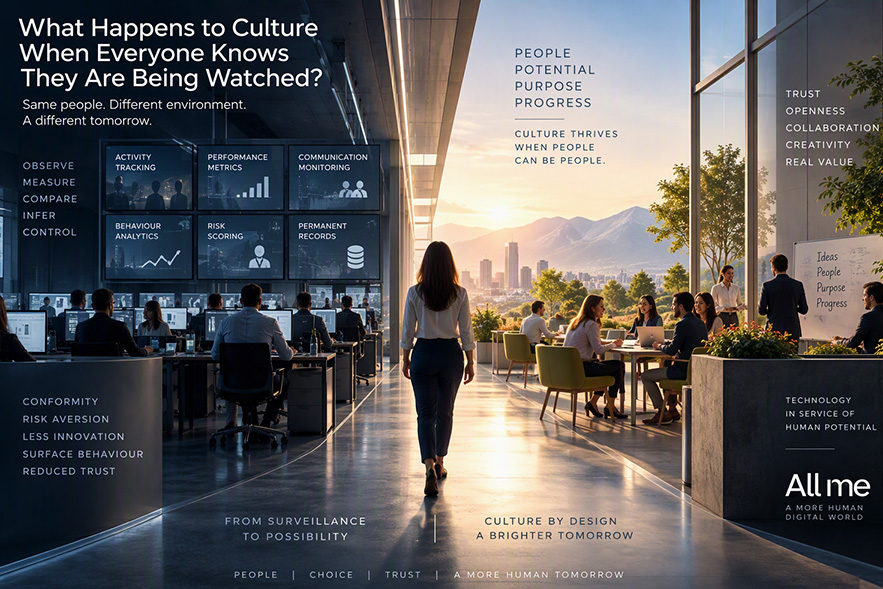
Walk through almost any large organisation and you will hear familiar ambitions.
We want people to:
- Collaborate.
- Challenge assumptions.
- Take sensible risks.
- Speak openly.
- Innovate.
- Learn from mistakes.
- Work across organisational boundaries.
- Take ownership.
These are reasonable aspirations.
So organisations create values around them.
They develop leadership programmes.
They run engagement surveys.
They redesign offices.
They create collaboration platforms.
They encourage people to speak up.
But there is another question that receives much less attention:
What does the organisation’s operating environment actually teach people to do?
Because culture is not simply what an organisation says.
Culture is what people learn is safe.
People adapt to the environment around them
Imagine an organisation saying:
We want people to challenge conventional thinking.
Now imagine employees know that almost everything they do can potentially become visible.
Activity can be recorded.
Performance can be measured.
Communication can be retained.
Relationships can become visible.
Contribution can be quantified.
Behaviour can be compared.
The organisation may sincerely want openness.
But the employee faces another question:
What happens to me if I get this wrong?
That question can be more powerful than any statement of corporate values.
When visibility changes behaviour
There is nothing inherently wrong with visibility.
Organisations need accountability.
Managers need information.
Businesses need to understand performance.
Regulated organisations have obligations.
But visibility can have consequences beyond the reason it was originally introduced.
When people know they are observable, they may change how they behave.
They may become more careful.
More conventional.
More aware of how actions might appear.
More conscious of who is watching.
More reluctant to say something that could later be misunderstood.
The organisation may think it has created greater transparency.
The employee may experience something different:
Greater exposure.
That distinction matters.
The safest behaviour can become the most visible behaviour
Consider two employees.
One quietly challenges assumptions, experiments, occasionally gets things wrong and ultimately discovers a better way of working.
Another produces everything expected, attends everything required, avoids controversial positions and consistently demonstrates the activities the organisation measures.
Who looks like the better employee?
That depends upon what the organisation can see.
The first employee may be creating more value.
The second may be creating more visible evidence of performance.
Once people understand what the organisation observes and rewards, behaviour can begin adapting to the measurement.
The organisation may then believe it is measuring culture.
In reality, it may increasingly be creating the culture it measures.
When collaboration becomes performance
This becomes particularly interesting with collaboration.
An organisation wants more collaboration.
So collaboration becomes measurable.
Meetings.
Messages.
Contributions.
Connections.
Responses.
Participation.
Activity.
Now imagine employees understand that these things contribute to how their engagement is perceived.
The meaning of collaboration begins to change.
People may still collaborate because collaboration is useful.
But another incentive has appeared.
Being seen to collaborate.
The activity and the appearance of the activity are no longer necessarily the same thing.
That is a cultural issue, not simply a measurement issue.
Culture is created by consequences
Most organisations have stated values.
But employees also encounter an unwritten set of organisational rules.
What gets rewarded?
What gets ignored?
What attracts criticism?
What damages a career?
What gains visibility?
What is remembered?
What is forgiven?
What follows someone after a mistake?
Those experiences teach people how the organisation actually works.
That is why changing culture is difficult.
You cannot simply announce:
Be more innovative.
If everything surrounding the employee teaches:
Do not fail.
You cannot say:
Challenge leadership.
If people learn that challenging leadership carries consequences.
You cannot say:
Be yourself.
While simultaneously constructing increasingly detailed mechanisms for observing and evaluating behaviour.
Culture emerges from the environment people experience.
The organisation may not intend to create conformity
As with many of the issues in this series, nobody needs to have bad intentions.
HR wants to understand engagement.
Leadership wants greater accountability.
Technology wants better information.
Risk wants stronger controls.
Management wants consistent performance.
Compliance wants evidence.
Each objective can be entirely legitimate.
But employees experience the combined environment.
And the combined message can unintentionally become:
Be careful.
Be measurable.
Be predictable.
Do what the organisation recognises.
That can become a powerful cultural force.
The problem does not therefore belong to one department.
It belongs to leadership.
For a greenfield organisation
A new organisation has an unusual opportunity.
It can decide how much observation is genuinely required before surveillance and measurement become embedded in everyday management.
It can ask:
What do we actually need to know to run the organisation?
What needs to be accountable?
What genuinely requires an audit trail?
What information helps somebody perform their role?
And then:
What are we observing simply because technology makes observation possible?
That last question matters.
Because every additional measure potentially changes the environment in which people work.
A greenfield organisation can decide that trust is not simply a corporate value.
It can make trust part of how the organisation actually operates.
For existing organisations
Established organisations face a different challenge.
Measurement may already exist everywhere.
- Performance systems.
- Productivity measures.
- Collaboration tools.
- Activity reporting.
- Employee analytics.
- Communication platforms.
- Management dashboards.
- Compliance systems.
The answer is not necessarily to remove them.
The leadership question is whether the organisation understands their combined cultural effect.
Look beyond why each system was introduced.
Ask instead:
What might an employee learn from experiencing all of them together?
Does the environment say:
We trust you to exercise judgement?
Or:
We need evidence that you are working?
Does it say:
Challenge us?
Or:
Everything you say may remain attached to you?
Does it say:
Experiment?
Or:
Failure will become part of your record?
Those messages may profoundly influence behaviour.
Trust cannot simply be declared
Many organisations say that they trust their people.
But trust becomes meaningful when someone has the opportunity to exercise judgement without constant observation.
That does not mean removing accountability.
Trust and accountability are not opposites.
The question is where the boundary sits.
An organisation can hold somebody accountable for an outcome without necessarily observing every step taken to achieve it.
It can establish responsibilities without constructing behavioural histories around employees.
It can govern without assuming that more visibility automatically produces better management.
This changes the leadership question from:
How can we see more?
to:
What do we genuinely need to see?
That is a much tougher question.
What happens to innovation?
Innovation depends partly upon uncertainty.
Someone has to suggest something that has not already been proven.
Someone has to question an established assumption.
Someone occasionally has to be wrong.
That becomes culturally difficult if people believe every unsuccessful experiment contributes to an enduring assessment of who they are.
People become rational.
They reduce exposure.
They choose safer options.
They avoid unnecessary conflict.
They minimise the possibility of visible failure.
And the organisation may eventually wonder why innovation has declined.
Perhaps the problem is not that employees stopped having ideas.
Perhaps they learned which ideas were safe to express.
Cultural transformation may require subtraction
Much of cultural transformation is additive.
- Add a new value.
- Add leadership training.
- Add communication.
- Add recognition programmes.
- Add employee initiatives.
But perhaps some cultural transformation requires the opposite.
Remove something.
- Remove unnecessary observation.
- Remove unnecessary behavioural measurement.
- Remove unnecessary historical judgement.
- Remove mechanisms that make people continually conscious of how their behaviour might be interpreted.
- Then see how people behave when the organisation creates more room for judgement, autonomy and trust.
That is a very different approach to cultural transformation.
A question for leaders
Look at your organisational culture.
Not the values on the website.
Not the leadership presentations.
Not the engagement survey.
Look at the environment employees actually experience.
Then ask:
How differently would people behave if they knew nobody was unnecessarily watching?
Would they challenge more?
Experiment more?
Speak more honestly?
Admit mistakes earlier?
Ask questions they currently avoid?
Cross organisational boundaries more freely?
If nothing would change, you may genuinely have a high-trust culture.
If behaviour would change significantly, another question becomes necessary:
Is the culture we see actually our culture, or is it the behaviour people have learned to display because they know they are being observed?
That is the adoption question behind ICCA: Cultural Transformation in Identity‑Constructed Organisations.
The underlying work examines the relationship between organisational visibility, behavioural memory, performance, conformity, hierarchy and surveillance, and considers what changes when those structural conditions are removed.
The underlying ICCA work is openly shared under a Creative Commons licence, with the published paper listed as CC BY 4.0.
Perhaps culture does not change when leadership tells people to behave differently.
Perhaps culture changes when leadership changes the environment that taught people how to behave in the first place.
#ICCA #OrganisationalCulture #CulturalTransformation #Leadership #Trust #HumanAutonomy #FutureOfWork #EmployeeExperience #DigitalTrust #OrganisationalDesign
