
You open an application.
You search for something.
You read something.
You buy something.
You talk to someone.
Then you leave.
From your perspective, the interaction may be finished.
But something may remain.
The organisation providing the technology may now know something it did not know before.
- What you looked at.
- What you ignored.
- What you selected.
- How long you stayed.
- What brought you there.
- Whether you returned.
- What you did next.
You experienced an interaction.
The system potentially gained information.
That difference creates something we rarely discuss when designing digital services:
Power.
When information creates power
Power in a digital relationship does not necessarily look like power.
There may be no coercion.
No instruction.
No obvious restriction.
The customer may be completely free to leave.
But consider the relationship.
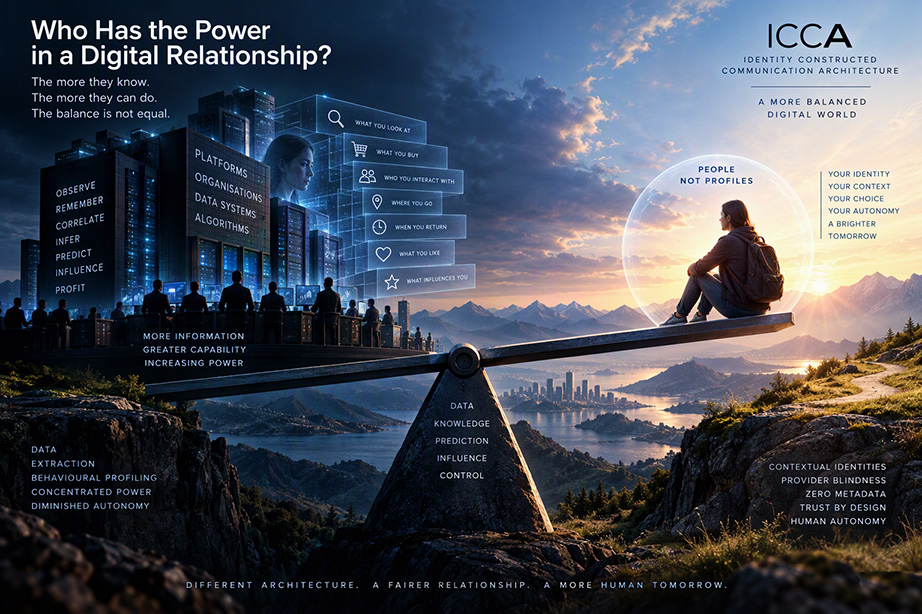
The individual typically knows relatively little about the organisation’s internal systems.
The organisation can potentially know considerably more about the individual.
The individual may remember today’s interaction.
The system can potentially connect today’s interaction with previous ones.
The individual sees what the system presents.
The system may know how the individual previously responded to what was presented.
Both parties are participating in the same relationship.
But they do not necessarily possess the same informational capabilities.
That is an asymmetry.
And information asymmetry can become power asymmetry.
The customer cannot see the other side
Imagine walking into a shop.
The shopkeeper remembers you.
Nothing particularly unusual about that.
Now imagine the shopkeeper could also remember:
- Every shelf you previously looked at.
- Everything you picked up but put back.
- How long you considered each product.
- Which offers attracted your attention.
- What you previously purchased.
- When you normally returned.
The relationship would be different.
The issue would not simply be that information existed.
The issue would be what one participant could do because that information existed.
Digital technology makes observation, retention, correlation and analysis possible at a scale that normal human relationships do not naturally have.
That changes the balance between the participants.
When observation becomes prediction
Once enough information accumulates, the purpose of observation can change.
The question is no longer simply:
What did this person do?
It can become:
What is this person likely to do?
And eventually:
What might cause this person to do something differently?
The progression is important.
- Observe.
- Remember.
- Correlate.
- Infer.
- Predict.
- Influence.
At each stage the informational advantage of the system can increase.
The individual is still making choices.
But the organisation may possess progressively greater knowledge with which to shape the environment in which those choices are made.
This relationship between data and power is increasingly visible in analysis of the platform economy. Research has examined algorithmic opacity and data asymmetry as dimensions of platform power, while other work connects data capture, platform intermediation and AI-enabled recombination with concentrated economic power.
What happens if the asymmetry cannot accumulate?
This is where ICCA introduces a very different proposition.
Much of this digital power depends upon continuity.
The system needs the ability to connect one interaction with another.
It needs information from which patterns can be constructed.
It needs sufficient visibility for behaviour to become history.
Remove unnecessary continuity and something interesting happens.
The service can still exist.
The interaction can still occur.
Trust can still be established.
But the provider’s ability to accumulate informational advantage changes.
ICCA therefore introduces a different architectural question:
What if the provider simply does not need to know?
Not because a policy tells the provider not to look.
Not because an organisation promises not to use the information.
But because unnecessary observation was never made a requirement of providing the service.
Power does not require bad actors
This distinction is important.
Discussions about digital power can easily turn into accusations about organisations deliberately exploiting customers.
That misses the deeper architectural issue.
We do not need a bad actor for power to accumulate.
Imagine an organisation collecting behavioural information because it wants to improve its service.
Then using that information to improve personalisation.
Then using personalisation to improve engagement.
Then using engagement information to improve recommendations.
Every individual decision might appear perfectly reasonable.
But step back.
Something else has happened.
The organisation has progressively increased its capability to understand the customer.
The customer has not necessarily acquired an equivalent capability to understand the organisation.
The asymmetry has increased without anybody explicitly deciding:
We want more power over our customers.
That is why digital power is an architectural question as much as an ethical one.
Provider blindness changes the relationship
ICCA approaches the problem structurally.
Provider blindness asks whether the organisation supplying infrastructure actually needs visibility into the interactions that infrastructure enables.
That creates a different possibility.
The organisation can provide the environment without automatically gaining informational power from everything occurring within it.
Two things that digital architectures frequently combine can begin to separate:
Providing the service.
And:
Observing the person using the service.
Those do not necessarily need to be the same capability.
Once they are separated, the power relationship changes.
For a greenfield business
A new digital business has an opportunity to decide how much informational power it actually wants before that power becomes embedded in its technology.
It can ask:
What information do we genuinely need to provide this service?
What are we collecting simply because technology makes collection possible?
What might we retain merely because it could become commercially useful later?
And perhaps most importantly:
What power over the customer are we creating by possessing this information?
That question rarely appears in conventional requirements gathering.
Perhaps it should.
Because collecting information does not simply create data.
It creates capability.
Capability creates possibilities.
And those possibilities can create power.
A different organisation might deliberately decide not to acquire unnecessary power in the first place.
For existing organisations
For established organisations, the question is harder.
Digital operating models may already contain:
- Customer profiles.
- Analytics.
- Behavioural histories.
- Recommendation systems.
- Personalisation.
- Marketing automation.
- Audience segmentation.
- Predictive models.
None of those capabilities automatically makes an organisation exploitative.
The leadership question is broader.
What power does their combination create?
An organisation might examine every system independently and conclude that each has a legitimate purpose.
The power dynamic may only become visible when they are considered together.
Leaders can therefore ask:
How much do we know about the customer?
How much does the customer know about what we know?
And then:
What can we do because of that difference?
This is not about making organisations powerless
Organisations need capabilities.
Banks need to operate accounts.
Retailers need to fulfil orders.
Employers need to employ people.
Governments need to provide public services.
Businesses need to make decisions.
Reducing unnecessary digital power does not mean removing legitimate organisational capability.
The important distinction is between:
the power necessary to fulfil the relationship
and:
the power accumulated by observing the individual beyond what that relationship requires.
Those are not the same thing.
From data minimisation to power minimisation
Data minimisation is normally discussed as a privacy principle.
Collect only what is necessary.
Retain only what is required.
But there may be another way to think about it.
Data minimisation can also be power minimisation.
If an organisation does not possess information, it cannot use that information to make additional inferences about an individual.
If interactions cannot unnecessarily be connected, they cannot as easily accumulate into behavioural histories.
If the provider does not need to observe an activity, that activity does not need to become another source of informational advantage.
This is not about redistributing digital power.
It is potentially something much more interesting.
Do not create unnecessary power in the first place.
A question for leaders
Look at the digital relationship your organisation has with its customers.
Then ask:
What can we know about them that they cannot know about us?
Then go further.
What can we infer?
What can we predict?
What can we influence because of those predictions?
And how much of that capability is genuinely necessary to provide the service the customer came to us for?
If all of it is genuinely necessary, there may be a legitimate reason for the asymmetry.
If some of it is not, another question becomes necessary:
Why have we designed the relationship to give ourselves that power?
That is the adoption question behind ICCA and Digital Power Dynamics.
It does not argue that organisations should become powerless.
It asks whether providing a digital service should automatically give one participant powers that the other participant cannot meaningfully reciprocate.
Perhaps digital trust should not depend entirely upon organisations promising to use their informational power responsibly.
Perhaps we should design digital relationships where unnecessary power never accumulates in the first place.
#ICCA #DigitalPower #DigitalTrust #HumanAutonomy #ProviderBlindness #DataMinimisation #PrivacyByArchitecture #DigitalEthics #ResponsibleTechnology #Leadership
