
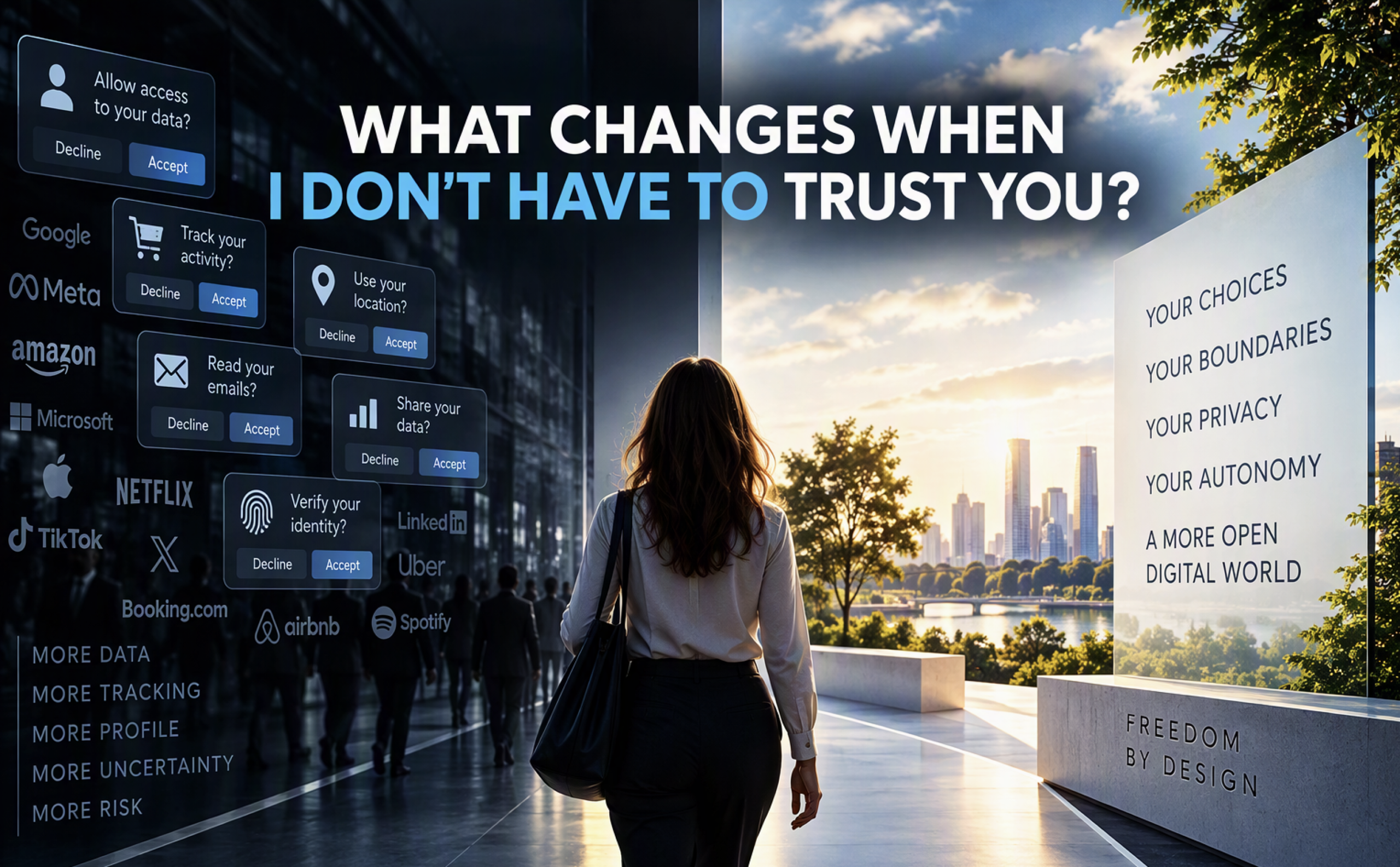
Trust is fundamental to almost every digital relationship.
We trust our bank to protect our money.
We trust retailers with our payment information.
We trust platforms with our conversations.
We trust organisations to use our personal information responsibly.
And we rely on privacy policies, regulation, governance and reputation to give us confidence that this trust is deserved.
Digital life has effectively become a vast network of promises:
Give us your information. Trust us to behave responsibly with it.
But what happens when the system no longer requires that trust?
Trust carries a psychological burden
Every time we give an organisation information, consciously or otherwise, we accept a degree of uncertainty.
- Will it be protected?
- Who can access it?
- What else might it be used for?
- Will it be shared?
- Will the organisation still exist in ten years?
- Will its policies change?
Most of the time we simply accept that uncertainty because participating in digital life leaves little alternative.
But consider a different relationship:
You don’t have to trust us not to misuse information we cannot see.
That changes more than privacy.
It changes the psychological relationship between the individual and the organisation.
From reassurance to certainty
Organisations invest considerable effort in reassuring customers.
- Privacy notices.
- Security statements.
- Consent mechanisms.
- Compliance certifications.
- Trust marks.
- Terms and conditions.
These mechanisms can be important, but fundamentally they communicate variations of:
Trust us. We have controls.
A structurally trustless system introduces a different proposition:
You don’t need the reassurance because the opportunity for certain behaviours has been removed.
There is an important psychological distinction between those two positions.
One asks the individual to evaluate a promise.
The other attempts to remove the need for that promise.
For a greenfield business
This creates an unusual opportunity.
Instead of asking:
How do we convince customers to trust us?
leaders can ask:
Which things could we design so customers never need to trust us with them?
That does not eliminate the importance of reputation.
Customers still need confidence in the product, service, organisation and commercial relationship.
But it could reduce the number of invisible promises contained within that relationship.
Trust can concentrate on the things that genuinely require it.
For existing organisations
Established organisations cannot simply remove every trust relationship.
Nor should they.
Instead, leaders can examine where trust currently exists because the architecture requires customers to accept organisational promises.
For every statement beginning:
“We will never…”
there is another question worth asking:
Could we eventually design this so that we cannot?
That is a very different way to approach customer trust.
Trustless does not mean untrustworthy
This distinction is particularly important.
The word trustless can sound negative.
It can imply distrust.
But the objective is almost the opposite.
A trustless system does not assume that organisations are dishonest.
It asks whether honesty should be the only thing preventing an undesirable outcome.
- Good people.
- Good organisations.
- Good policies.
- Good governance.
- All remain important.
But architecture can provide another boundary.
The strongest promise may sometimes be the one an organisation is structurally incapable of breaking.
The implications for leadership
This shifts trust from being primarily a communications challenge towards becoming a design question.
Leaders can begin asking:
Where does our customer proposition depend upon people trusting our intentions?
Where could architecture reduce that dependency?
And what happens to the customer relationship when people no longer need to worry about what we might do?
The result could be something more valuable than increased trust.
It could be reduced need for trust.
A question for leaders
Look at the promises your organisation asks customers to believe.
Then ask:
If we were designing this relationship again today, how many of those promises could we make unnecessary?
That is the adoption question behind ICCA and the Psychology of Trustless Systems.
The paper explores trustless systems from a psychological perspective.
The adoption question is simpler:
What happens to the relationship between an organisation and a person when the person no longer needs to hope the organisation will do the right thing?
The underlying ICCA work is openly shared under a Creative Commons Attribution-ShareAlike 4.0 licence, encouraging discussion, challenge, adaptation and further development.
Perhaps the future of digital trust isn’t about asking people to trust organisations more. Perhaps it is about giving them fewer reasons to need that trust in the first place.
#ICCA #DigitalTrust #TrustByDesign #PsychologyOfTrust #CustomerTrust #HumanAutonomy #Leadership #PrivacyByDesign #DigitalTransformation #CreativeCommons
