
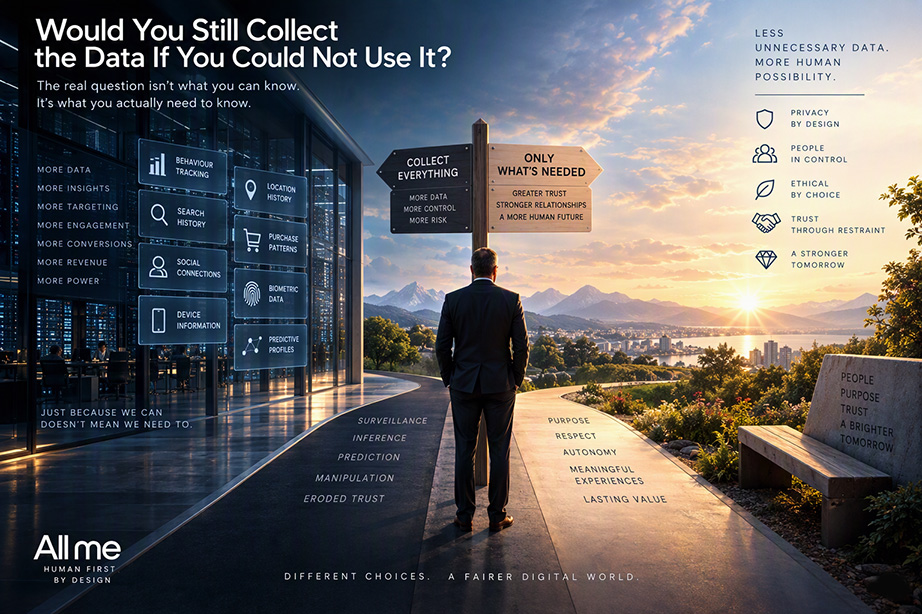
Most organisations collect data for perfectly reasonable reasons.
- To improve the service.
- To understand customers.
- To personalise experiences.
- To measure performance.
- To manage risk.
- To identify opportunities.
- To make better decisions.
Individually, each reason can make sense.
But there is another question organisations rarely ask:
If we did not have the ability to collect this information, could we still provide the service?
That is a very different question.
Because it moves the conversation away from what an organisation can know.
And towards what an organisation actually needs to know.
Just because we can does not mean we need to
Digital technology has made observation remarkably easy.
A physical business might know that a customer entered a shop and purchased something.
A digital business can potentially know much more.
- What was viewed.
- What was ignored.
- What was searched for.
- What was selected.
- What was abandoned.
- What was returned to.
- How long something was considered.
- What happened before the purchase.
- What happened afterwards.
- The technology makes this possible.
But technological possibility is not the same thing as business necessity.
That distinction matters.
Data collection has become normal
Imagine proposing a new digital service twenty-five years ago.
Someone in the meeting says:
We should record everything the customer does.
There might have been questions.
Why?
What are we going to do with it?
Do customers expect this?
Do we actually need it?
Who should have access?
How long should we keep it?
Today the situation can be very different.
Collection can become the default.
The unusual decision can be not collecting something.
That reveals how far the underlying assumption has shifted.
The question is no longer always:
Why should we collect this?
It can become:
Why wouldn’t we?
Perhaps that question is the wrong way around.
Ethics often arrives after the technology
Organisations increasingly take digital ethics seriously.
There are principles.
- Policies.
- Governance structures.
- Reviews.
- Committees.
- Codes of conduct.
- Responsible technology programmes.
These are valuable.
But there is an interesting limitation.
Much of digital ethics begins after a capability already exists.
The organisation can collect the information.
The system can observe behaviour.
The data can be connected.
The analysis can be performed.
The prediction can be generated.
Ethics is then asked:
Under what circumstances should we use this capability?
There is another possible approach.
Ask:
Should we create the capability in the first place?
That is a much more fundamental design question.
Restraint is difficult when capability already exists
Imagine an organisation possesses a large amount of customer information.
The information was collected for legitimate reasons.
Then someone discovers another useful application.
Later, another.
Then another.
Each new use may make commercial sense.
The original decision to collect something has created possibilities that did not exist before.
That is why data ethics cannot only concern how information is used.
It also needs to consider the consequences of possessing the information at all.
Because possession creates capability.
Capability creates opportunity.
Opportunity creates temptation.
And eventually, something previously considered unnecessary may become normal simply because it has become possible.
What if good design removed the temptation?
There is an established way of thinking about responsible organisations.
Give them power.
Create rules governing that power.
Monitor compliance.
Hold people accountable when the rules are broken.
That model is necessary in many areas of business.
But digital technology creates another possibility.
Sometimes we can design systems so that unnecessary power never needs to exist.
The organisation does not need to promise:
We won’t look.
If the organisation cannot unnecessarily look.
It does not need to promise:
We won’t correlate this information.
If unnecessary correlation cannot occur.
It does not need to continually reassure customers:
Trust us.
If the service has been designed so that particular forms of trust are simply unnecessary.
That changes the nature of ethical design.
It moves ethics from organisational restraint towards structural restraint.
For a greenfield business
A new business has an unusual opportunity.
Before customer data becomes embedded throughout the organisation, leadership can ask:
What information is genuinely necessary?
What do we need to complete the transaction?
What do we need to provide the service?
What do we need for legitimate accountability?
What do we need to meet our obligations?
Then stop.
Do not automatically add:
What else might be useful later?
That apparently innocent question can completely change the relationship.
Instead, ask:
What is the minimum knowledge required for us to create maximum customer value?
That is a very different design principle.
And it can produce a very different organisation.
For existing organisations
Established businesses face a harder question.
Information is already everywhere.
- Customer records.
- Analytics.
- Marketing systems.
- Transaction histories.
- Profiles.
- Personalisation.
- Recommendations.
- Data warehouses.
- AI systems.
- Management reporting.
The answer is not necessarily to delete everything or dismantle systems that have legitimate purposes.
It is to challenge the assumption that existing capability automatically justifies continuing capability.
Leadership can ask:
Why do we possess this information?
Do we still need it?
What customer value depends upon it?
What organisational power does possessing it create?
Would we deliberately choose to collect it if we were designing the business today?
That final question can be particularly revealing.
Privacy is not the same thing as blindness
A privacy-conscious organisation can still know an enormous amount about somebody.
- It can have excellent governance.
- Strong security.
- Careful access controls.
- Responsible employees.
- Clear policies.
- Good intentions.
- Those things matter.
But they do not alter one fundamental fact:
The organisation still possesses the information.
That creates a useful distinction.
Privacy asks:
How responsibly will you handle what you know about me?
Blindness asks:
Why do you need to know it at all?
Those are profoundly different propositions.
Trust can sometimes be replaced by design
Businesses spend enormous amounts of effort trying to create trust.
- Trust our brand.
- Trust our security.
- Trust our governance.
- Trust our employees.
- Trust our privacy policy.
- Trust us with your information.
Perhaps there is another form of trust available.
The confidence created when customers understand that the organisation deliberately chose not to acquire unnecessary knowledge about them.
That is not trust created by a promise.
It is trust created by restraint.
And where restraint is embedded into design, the customer does not need to continually evaluate whether the organisation will behave responsibly.
The dependency on trust itself can begin to shrink.
Ethical leadership means deciding what not to build
Technology leadership is frequently associated with capability.
What can we create?
What can we automate?
What can AI discover?
What can data tell us?
What can we personalise?
What can we predict?
Those are important questions.
But perhaps mature digital leadership requires another capability:
Knowing what not to build.
Not because regulation prevents it.
Not because technology cannot do it.
Not because customers complained.
But because leadership decided the capability was unnecessary for the relationship the organisation wanted to have with its customers.
That is restraint by choice.
And that is an ethical decision.
A question for leaders
Look at the information your organisation collects.
Then choose one piece of information and ask:
What customer value would disappear if we stopped collecting this?
If there is a clear answer, there may be a legitimate reason for collecting it.
If there is no clear answer, ask:
Why do we have it?
Then go further:
Are we collecting information because the customer relationship requires it, or because digital technology makes collecting it easy?
And finally:
If we were designing this business again today, knowing everything we now understand about digital trust, would we deliberately give ourselves this capability?
That is the adoption question behind ICCA: Ethical Design Principles for Blind‑Provider.
It asks us to reconsider a deeply embedded assumption of the digital economy:
That providing a digital service naturally requires seeing the people using it.
Perhaps ethical technology should not be measured only by how responsibly organisations use the information they possess.
Perhaps the more fundamental measure is how little unnecessary information they choose to possess in the first place.
#ICCA #EthicalTechnology #DigitalEthics #DigitalTrust #PrivacyByDesign #ResponsibleTechnology #DataMinimisation #CustomerTrust #HumanAutonomy #Leadership
