Skip to content
November 23, 2026
Linkedin Instagram Twitter
All me logo

All me

secure anonymous privacy by default personal and professional networking without advertising

  • Home
  • About
  • Founder
  • Contact
  • Privacy Policy
  • About
  • Founder
  • Contact
  • ICCA
    • Building Trust Without Visibility
      • Why Am I Expected to Trust Everyone?
      • Why is my identity stored everywhere except with me?
      • Why does every digital interaction leave a trail?
      • Why do we assume organisations need to see everything?
    • Designing for Human Autonomy
      • Why Do I Have to Give You My Data Before You Give Me a Service?
      • Why Does Providing Me a Service Mean You Need to See Me?
      • Why Should My Activity Reveal More About Me Than the Interaction Requires?
      • Why Should I Have to Trust Your Promises?
      • Why Does Saying Yes to One Thing Mean Saying Yes to Everything?
      • What If Knowing Less About Me Was Better for Business?
      • Why Is Technology Constantly Trying to Influence My Choices?
      • What If Watching Me Had No Commercial Value?
      • Why Does Everything Online Seem to Want Something From Me?
    • Governing Without Surveillance
      • Do We Really Need to See Everything to Manage Risk?
      • Does Organisational Control Really Require More Oversight?
      • Does Accountability Require Everyone to See Everything?
    • Creating Value Without Exploiting Behaviour
      • What If My Customer’s Behaviour Wasn’t Part of My Business Model?
      • What Happens When Data Stops Being Strategic Power?
    • Designing Technology That Leaves People in Control
      • What If the Data You Collect Is Actually Your Liability?
      • What Changes When I Don’t Have to Trust You?
      • What Changes When People Know They Aren’t Being Watched?
      • Who Is Actually Making My Choices Online?
      • What If a Successful Digital Experience Ended When I Was Finished?
      • Why Does Technology Keep Trying to Bring Me Back?
    • Creating Digital Spaces Where People Can Be Human
      • Who Decides Who You Are Online?
      • Who Has the Power in a Digital Relationship?
      • When Does Customer Engagement Become Customer Engineering?
      • Does Your Digital Service Respect Your Customer’s Attention?
      • What Happens to Culture When Everyone Knows They Are Being Watched?
      • Would You Still Collect the Data If You Could Not Use It?
  • Jobs
    • The All me Retainer Model
    • All me Retainer FAQ
    • All me Non‑Compete Summary
  • Privacy Policy
Random News
  • Home
  • All me app
  • All me the vault you live In
  • Home
  • About
  • Founder
  • Contact
  • Privacy Policy

Archives

  • November 2026
  • October 2026
  • September 2026
  • August 2026
  • July 2026
  • June 2026
  • May 2026
  • April 2026
  • March 2026
  • February 2026
  • January 2026
  • November 2025
  • October 2025
  • September 2025
  • February 2025
  • January 2025
  • December 2024
  • November 2024
  • October 2023
  • July 2023
  • March 2023

Categories

  • Agile
  • All me app
  • All me OS
  • All me Supporters
  • Founder
  • ICCA
  • Interview
  • Kickstarter support
  • Omega Foundation
  • Press Release
  • Privacy by Default
  • Research
  • Strategy
  • what
  • Why
All me vault security model
  • All me app

All me the vault you live In

AdminJuly 1, 2026July 7, 202607 mins

The Vault You Live In: How All me Redefines Digital Identity and Protects People Without Knowing Who They Are

Most digital platforms treat identity as something that must be exposed to be protected. You enter a system, you are recognised, and the platform builds a picture of who you are your behaviour, your connections, your preferences, your risks. Even when companies promise privacy, the architecture still assumes visibility. Someone, somewhere, is always watching.

All me takes a different path.

It is not a room where people gather and hope no one is looking. It is a vault a private, sealed, zero‑trust environment that protects the person inside even when the system does not know who that person is.

This is the foundation of All me’s security model: protection without identification.

Why anonymity is not a weakness it is the shield

In traditional systems, anonymity is treated as a vulnerability. If a platform cannot identify you, it cannot protect you. It cannot verify you. It cannot recover your account. It cannot prevent impersonation.

All me reverses this assumption.

Anonymity is not a gap. It is a structural defence.

The anonymous account in All me contains:

  • no name
  • no email
  • no phone number
  • no behavioural history
  • no social graph
  • no personal identifiers of any kind

There is nothing to steal, nothing to leak, and nothing to correlate. Even if someone tried to impersonate you, they would be impersonating nobody a profile with no personal value and no personal data.

This is the first wall of the vault.

The vault metaphor: how All me protects people it does not identify

A vault does not need to know who lives inside. It only needs to verify the key.

All me uses a combination of:

  • device‑bound authentication
  • non‑sequential identity spaces
  • external 2FA authority via verified payment identity
  • zero‑trust compartmentalisation
  • local profile generation with no server‑side personal data

These elements create a structure where:

  • the system does not know who the user is
  • the system does not store anything that could reveal who the user is
  • the system cannot reset access without the user’s verified payment identity
  • the system cannot be tricked into revealing or linking identities

The vault protects the resident without needing to know the resident.

Why describing the model does not compromise security

Many platforms avoid explaining their security architecture because revealing it exposes attack surfaces. All me does not rely on secrecy. It relies on absence.

There is no:

  • password reset path to attack
  • personal data to extract
  • identity to impersonate
  • behavioural model to exploit
  • cross‑profile linkage to infer

Explaining the architecture does not give attackers leverage because the architecture deliberately removes the leverage points.

Transparency strengthens trust without weakening protection.

Can an attacker steal an anonymous account?

No.

The only way an anonymous account is lost is through user‑side loss of the cryptographic artefacts that unlock the vault:

  • the device‑bound authentication key
  • the generated username
  • the 2FA password
  • the local profile seed

An attacker cannot:

  • reset the 2FA (requires verified payment identity)
  • bypass the device challenge
  • extract personal data (none exists)
  • impersonate the user at the gateway
  • persistently hijack the account

Even a fake UI or man‑in‑the‑middle attack can only collect useless artefacts that cannot be replayed or reset.

The vault cannot be opened from the outside.

Why this matters for the future of digital identity

Most digital systems assume that identity must be known to be protected. All me demonstrates the opposite: identity can be protected precisely because it is not known.

This model:

  • reduces risk
  • eliminates high‑value targets
  • prevents correlation
  • blocks impersonation
  • removes the incentive for attack
  • gives users control without exposing them

It is a privacy‑first architecture designed for a world where personal data has become both currency and liability.

All me is not a place where people hide.

It is a place where people are protected.

A new paradigm: protection without visibility

The digital world has spent decades building systems that watch, record, infer, and predict.

All me is part of a different movement one that treats privacy not as an optional feature but as a structural requirement.

A vault does not need to know who you are. It only needs to keep you safe.

All me is that vault.

Loading

Tagged: 2FA security All me anonymous identity cryptographic key data minimization device bound authentication digital safety digital vault identity protection non sequential identity payment gateway verification privacy technology privacy‑first secure ecosystem secure login trustless authentication user anonymity vault model zero knowledge design zero trust architecture

Post navigation

Previous: A discovery concept ahead of its time
Next: Identity Constructed Communication Architecture (ICCA)

Related Posts

ICCA Adoption Articles

ICCA Adoption Articles

AdminNovember 10, 20260
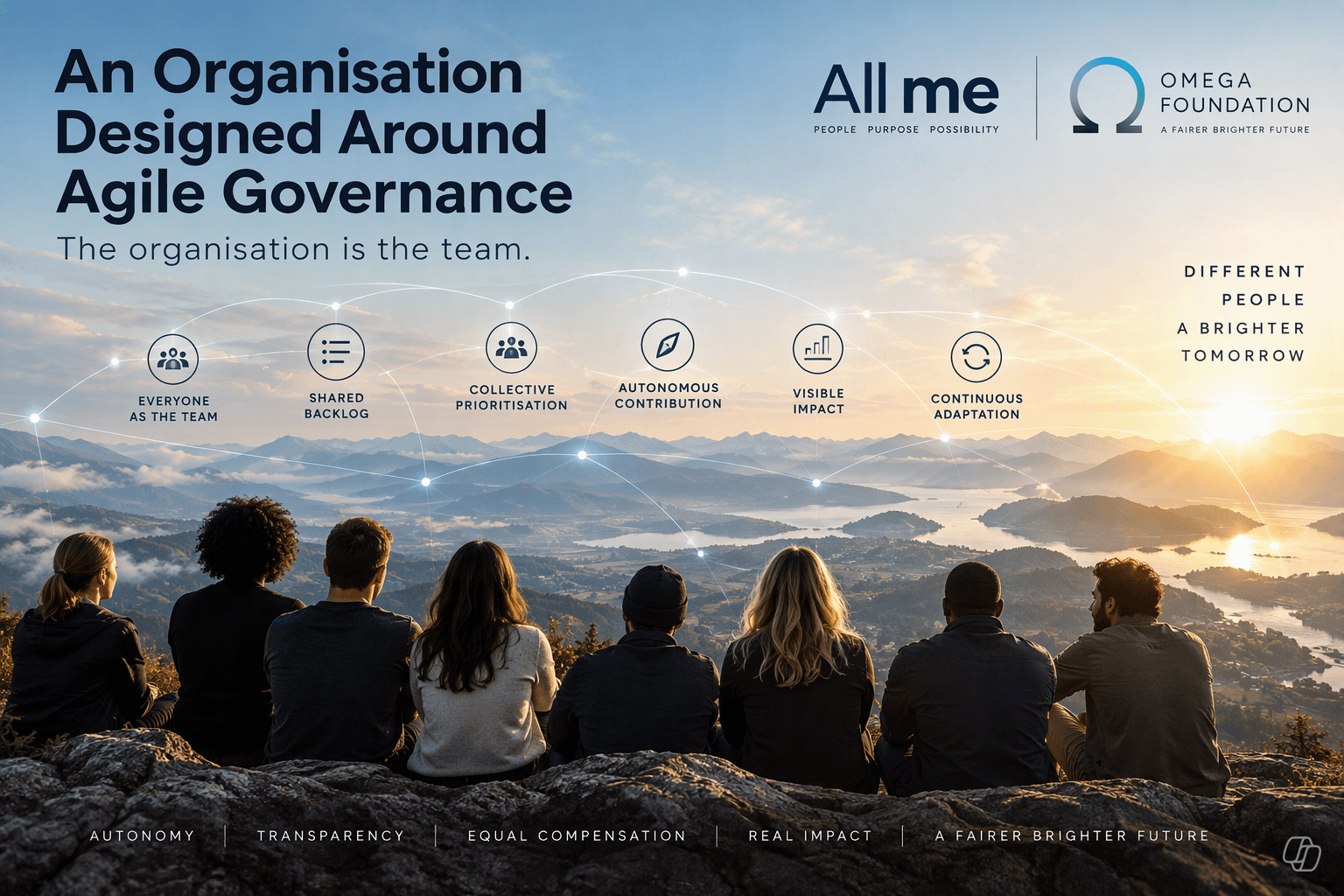
All me an Organisation Designed Around Agile Governance

All me an Organisation Designed Around Agile Governance

AdminOctober 4, 2026October 4, 20260
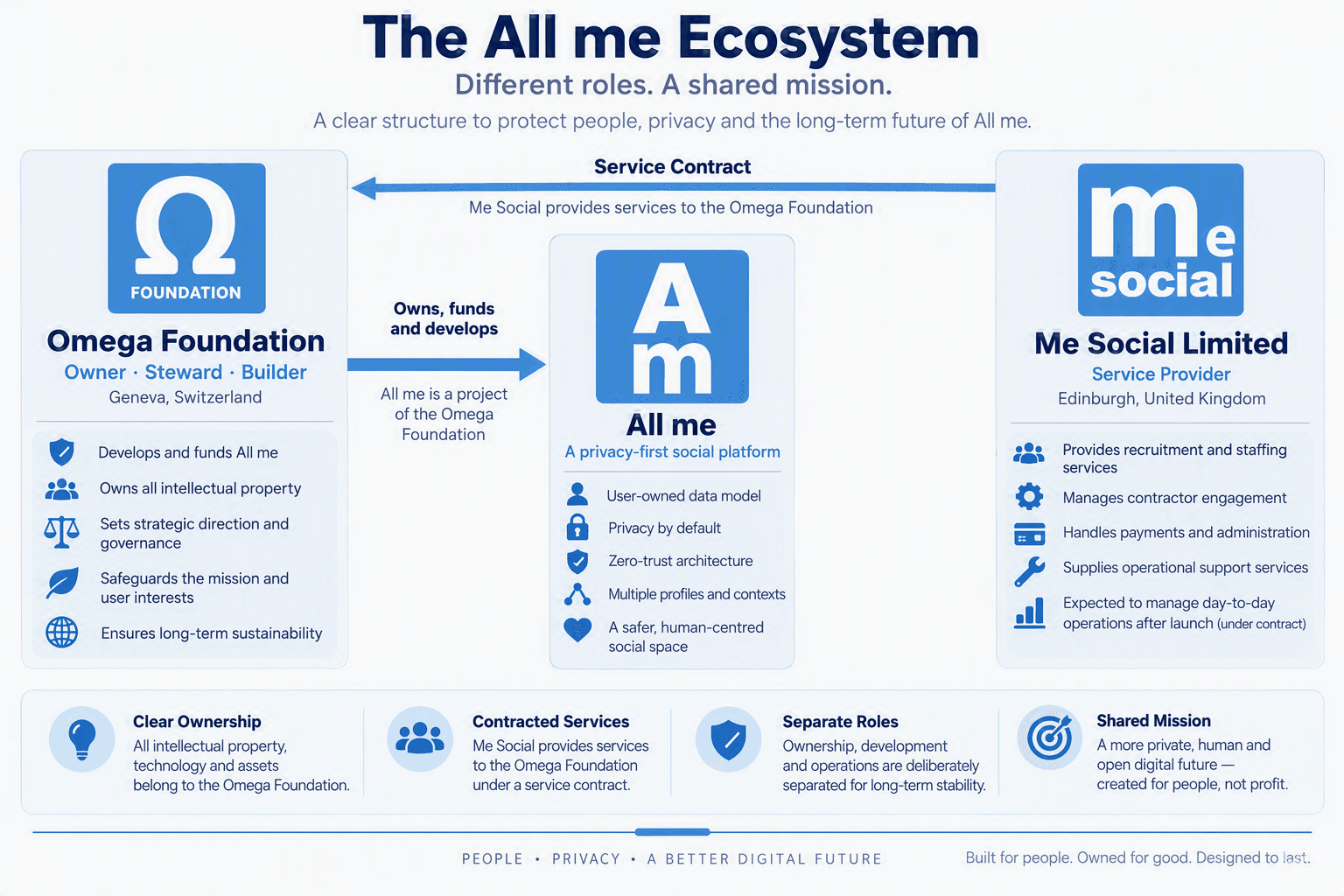
Omega Foundation Project All me and Service Provider Me Social

Development Update: Who Is Actually Building All Me?

AdminSeptember 25, 20260
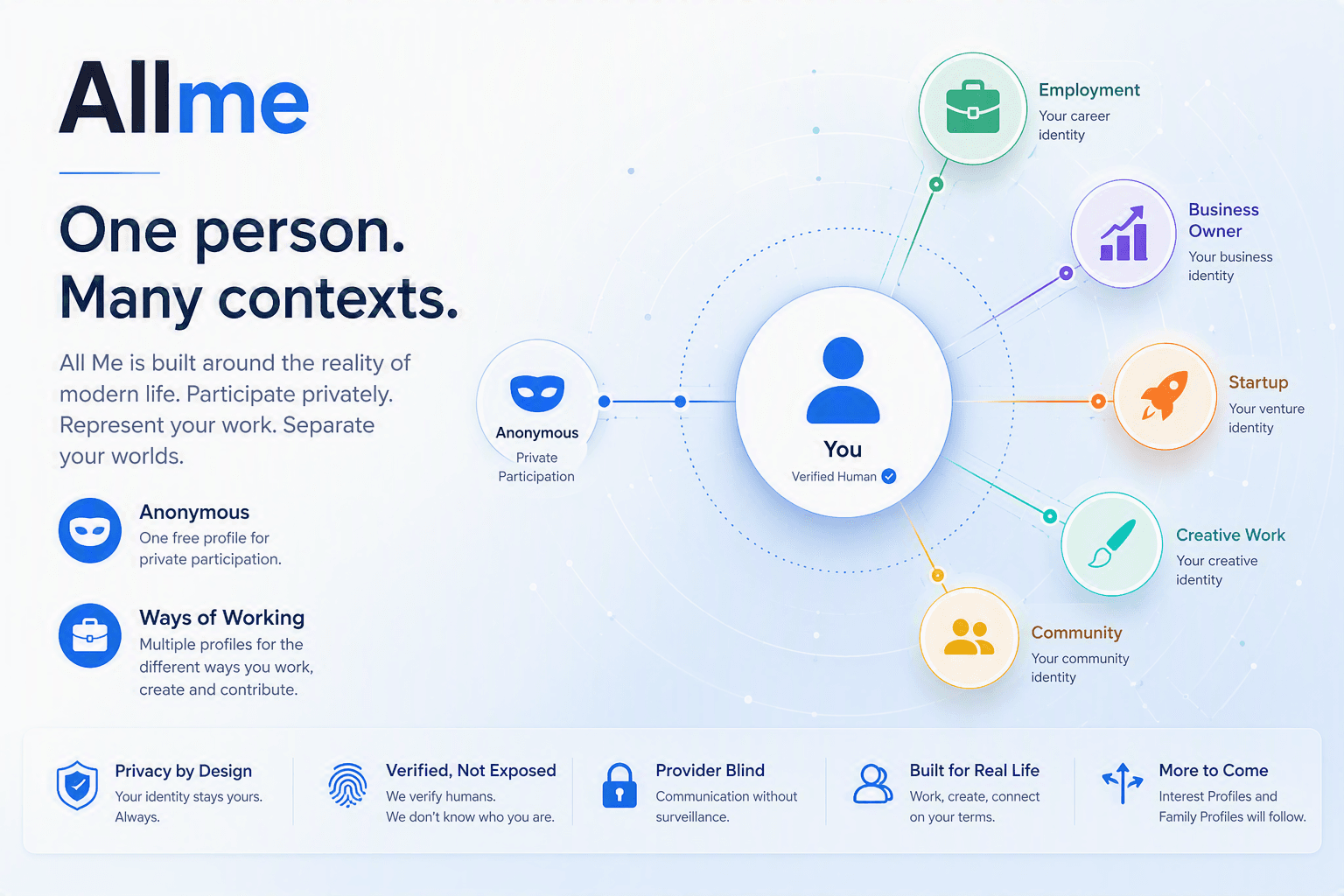
All me profile structure at launch

Development Update: Profile Structure at Launch

AdminSeptember 21, 20260

Recent Posts

  • ICCA Adoption Articles
  • Building a Third-Party Ecosystem on ICCA
  • All me an Organisation Designed Around Agile Governance
  • Development Update: Who Is Actually Building All Me?
  • Development Update: Profile Structure at Launch
Copyright © 2024 All me by Omega Foundation.