
Why We Are Publishing the ICCA Architecture
One question we are occasionally asked is:
If Identity Constructed Communication Architecture (ICCA) forms the architectural foundation of All Me, why would you publish it?
The answer is simple.
Because trust should not depend on secrecy.
The technology industry has a long history of asking people to trust systems they cannot see, understand or evaluate. Users are often expected to accept claims about privacy, security and data protection without being able to examine the underlying assumptions.
We believe that approach is increasingly inadequate.
All Me is being built on a set of architectural principles known as the Identity Constructed Communication Architecture (ICCA). These principles define how identity, privacy, communication, trust and discovery are intended to operate within the platform.
Rather than treating these concepts as proprietary secrets, we have chosen to publish them.
Architecture Should Be Open To Scrutiny
Publishing the ICCA papers allows researchers, technologists, regulators, privacy advocates and the wider public to understand the thinking behind the platform.
People should be able to challenge ideas.
They should be able to identify weaknesses.
They should be able to suggest improvements.
And they should be able to understand the principles upon which a system is built.
Architectural transparency creates stronger systems.
The Blueprint Is Not The Building
The ICCA publications describe the architectural blueprint.
They do not provide the complete implementation, infrastructure, operational security model or source code of the All Me platform.
Just as publishing the architectural drawings of a building does not construct the building itself, the ICCA papers describe the design principles that guide development rather than every implementation detail.
Encouraging Broader Discussion
The challenges ICCA attempts to address are not unique to All Me.
Questions surrounding privacy, digital trust, identity, surveillance, data ownership and platform responsibility affect the entire digital ecosystem.
By publishing the architecture under a Creative Commons licence, we hope to encourage wider discussion about these issues and contribute to the development of future digital systems, whether they are connected to All Me or not.
Building Trust Through Understanding
Ultimately, we believe trust grows when people are given the opportunity to understand.
All Me is not asking people to trust us because we say the platform is different.
We are publishing the thinking, principles and architectural foundations so that people can evaluate those claims for themselves.
That level of transparency may be unusual in the technology sector.
We believe it should become normal.
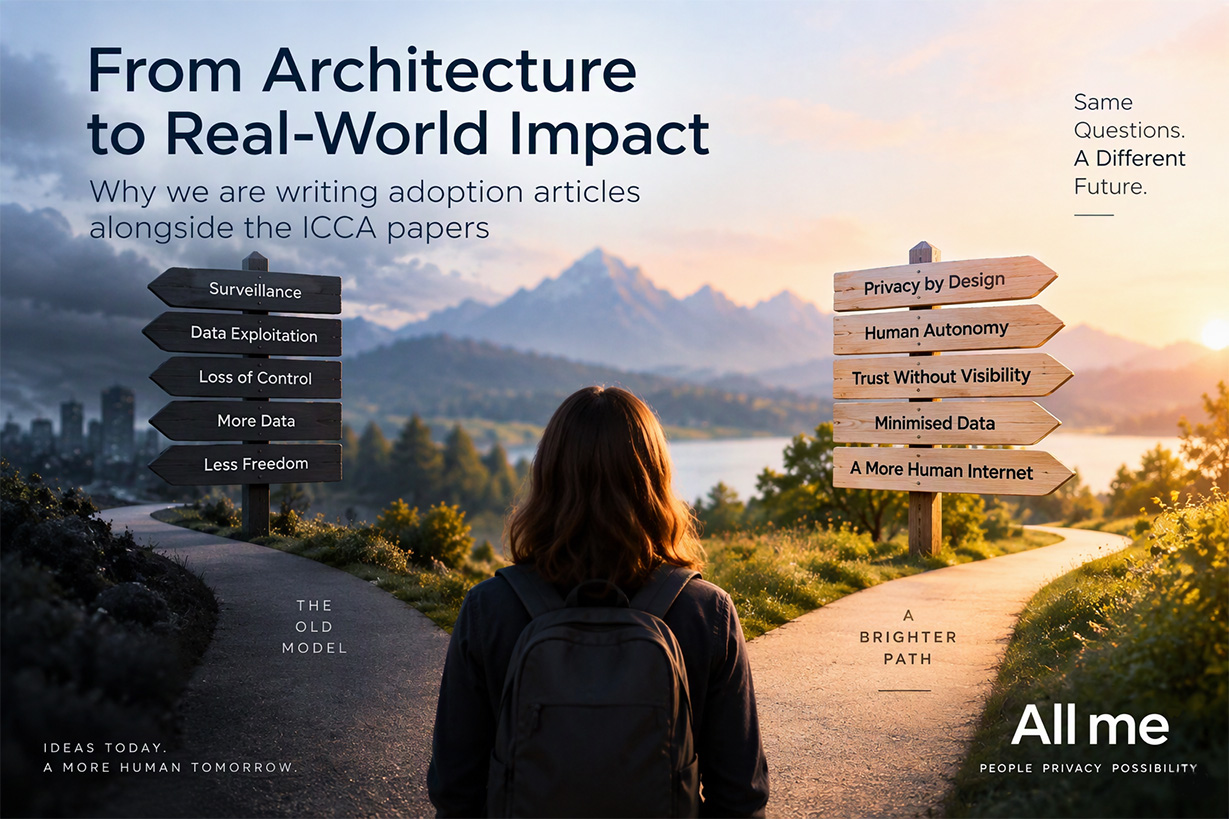
Why We Are Writing Adoption Articles Alongside The Papers
The ICCA papers are written as architectural documentation.
Their purpose is to document the principles, structures and operating models that underpin the All Me platform.
However, most people are not architects, cryptographers or systems engineers.
Nor should they need to be.
For that reason, we are publishing a parallel series of adoption articles that explore the implications of the architecture rather than the technical details.
These articles ask questions that matter to everyday users, business leaders, regulators and policymakers:
Building Trust Without Visibility
- Why am I expected to trust everyone?
- Why is my identity stored everywhere except with me?
- Why does every digital interaction leave a trail?
- Why do we assume organisations need to see everything?
Designing for Human Autonomy
- Why Do I Have to Give You My Data Before You Give Me a Service?
- Why Does Providing Me a Service Mean You Need to See Me?
- Why Should My Activity Reveal More About Me Than the Interaction Requires?
- Why Should I Have to Trust Your Promises?
- Why Does Saying Yes to One Thing Mean Saying Yes to Everything?
- What If Knowing Less About Me Was Better for Business?
- Why Is Technology Constantly Trying to Influence My Choices?
- What If Watching Me Had No Commercial Value?
- Why Does Everything Online Seem to Want Something From Me?
Governing Without Surveillance
- Do We Really Need to See Everything to Manage Risk?
- Does Organisational Control Really Require More Oversight?
- Does Accountability Require Everyone to See Everything?
Creating Value Without Exploiting Behaviour
- What If My Customer’s Behaviour Wasn’t Part of My Business Model?
- What Happens When Data Stops Being Strategic Power?
Designing Technology That Leaves People in Control
- What If the Data You Collect Is Actually Your Liability?
- What Changes When I Don’t Have to Trust You?
- What Changes When People Know They Aren’t Being Watched?
- Who Is Actually Making My Choices Online?
- What If a Successful Digital Experience Ended When I Was Finished?
- Why Does Technology Keep Trying to Bring Me Back?
Creating Digital Spaces Where People Can Be Human
In progress
Rather than explaining how ICCA works, these articles explore what ICCA could mean.
They examine the potential implications for privacy, trust, digital identity, organisational design, governance and the future relationship between people and technology.
In many ways, the adoption articles are the bridge between the architectural blueprint and the real world.
The papers describe the architecture.
The articles explore its significance.
Both are necessary.
Understanding how something works is important.
Understanding why it matters is equally important.
The ICCA papers are published under the Creative Commons Attribution-ShareAlike (CC BY-SA 4.0) licence and are available for reading, discussion, adaptation and academic review.
Because trust should be earned through understanding, not demanded through obscurity.
